




Cosmic Cities on a Grand Scale
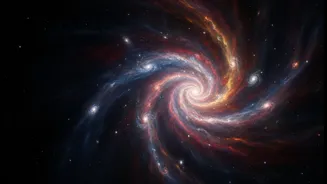
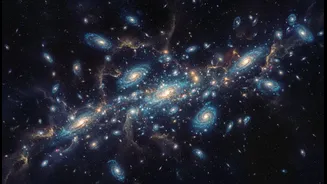
Imagine cities not of buildings, but of entire galaxies. That’s a galaxy cluster. These are the most massive, gravitationally bound objects in the universe, containing hundreds or even thousands of galaxies like our own Milky Way. They are colossal structures,
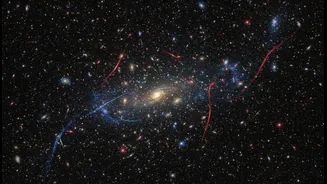
held together by an immense gravitational pull, a significant portion of which comes from the mysterious, invisible substance known as dark matter. For cosmologists, these clusters are not just beautiful objects; they are crucial laboratories. Because they are so massive, they warp the fabric of spacetime around them, a phenomenon predicted by Albert Einstein called gravitational lensing. This effect turns the cluster into a natural magnifying glass, allowing astronomers to see even more distant galaxies lying behind them, offering a glimpse into the universe's infancy.
The View Before Webb
For decades, the Hubble Space Telescope gave us breathtaking views of the cosmos, including some galaxy clusters. However, Hubble primarily sees in visible and ultraviolet light. This limited its ability to peer through the dense cosmic dust that often shrouds the most interesting and distant objects. The universe's expansion also stretches light from the most ancient galaxies into longer, redder wavelengths—specifically, infrared light—that were largely invisible to Hubble. While it could spot some features, many of the finer details and more distant lensed galaxies within these clusters remained hidden, like trying to read a book through a foggy window. Astronomers knew there was more to see, but they needed a new set of eyes.
An Infrared Revolution
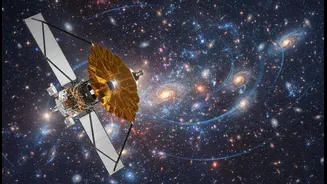
Enter the James Webb Space Telescope (JWST). Launched in late 2021, Webb is an observatory designed specifically to see the universe in infrared light. Its massive, gold-coated mirror and highly sensitive instruments allow it to cut through the cosmic dust and capture the faint, stretched-out light from the dawn of time. For the study of galaxy clusters, this is a complete game-changer. What appeared as faint smudges or were entirely invisible to Hubble are now resolving into bright, detailed galaxies. This capability has officially ushered in what astronomers are calling the "Webb era," a new chapter in our quest to understand cosmic origins.
Stunning Early Discoveries
The early returns from Webb have been nothing short of spectacular. Take Pandora's Cluster (Abell 2744), a massive merger of at least four galaxy clusters. Webb's deep-field image of this region revealed roughly 50,000 new sources of near-infrared light, uncovering details and distant lensed galaxies never seen before. Similarly, observations of the El Gordo cluster, Spanish for "The Fat One," showed a wealth of distorted background galaxies. One prominent feature, a lensed galaxy nicknamed "The Fishhook," had its light travel 10.6 billion years to reach us. More recently, in June 2026, Webb studied a cluster named XLSSC 122, finding it to be surprisingly mature for its age of just 3.4 billion years after the Big Bang, challenging existing models of cosmic evolution. Its ability to act as a strong gravitational lens, something not definitively seen by Hubble, was a welcome surprise for scientists.
Rewriting Cosmic History
These new observations are doing more than just providing pretty pictures; they are forcing a rewrite of our cosmic timeline. The discovery of highly evolved clusters like XLSSC 122 so early in the universe's history suggests that these massive structures may have formed much faster than previously thought. The patterns of gravitational lensing also provide a powerful new way to map the distribution of dark matter, which makes up about 75% of a cluster's mass. By studying how light is bent, astronomers can measure the location and concentration of this invisible matter without ever seeing it directly. This is a critical piece of the puzzle for understanding how the cosmic web—the large-scale structure of the universe—was assembled. The sheer number of discoveries, from impossibly large black holes to galaxies that stopped spinning far too early, has become a familiar pattern in the Webb era, constantly challenging and refining our models of the cosmos.