


First, What Exactly Is a Quasar?
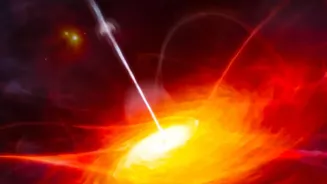
Before diving into the discovery, it helps to know what we're looking at. A quasar, short for 'quasi-stellar object', is one of the brightest and most energetic things in the universe. It’s not a star, but the intensely luminous core of a distant galaxy.
At the heart of this core is a supermassive black hole, millions or even billions of times the mass of our sun. As this cosmic giant greedily pulls in surrounding gas and dust, the material forms a swirling, superheated disc. The immense friction and gravitational forces cause this disc to glow with unimaginable brightness, often outshining all the stars in its host galaxy combined. Because they are so bright, quasars act as cosmic beacons, allowing astronomers to study the very early universe.
Two Giants at the Dawn of Time
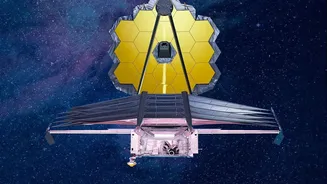
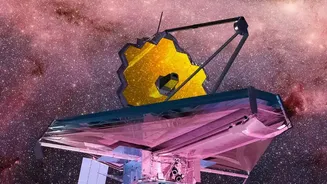
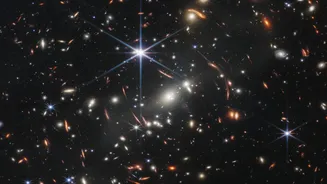
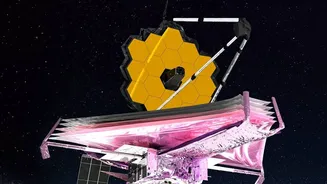
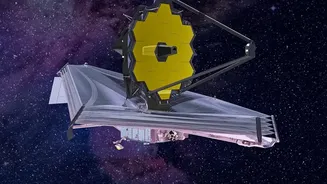
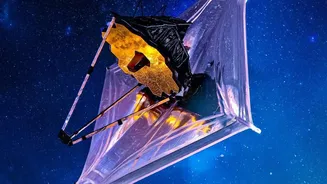
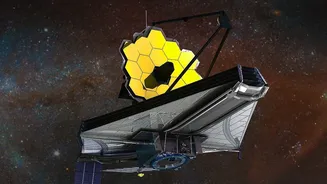
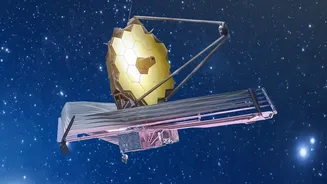
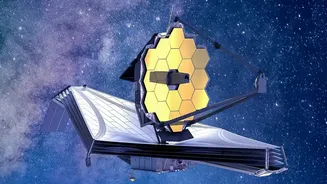
Using data from the James Webb Space Telescope (JWST) and the Gemini North telescope in Hawai'i, astronomers identified the most distant compact pair of quasars ever found. Nicknamed Nāpōwawāʻenakaulua, the system is seen as it was just 900 million years after the Big Bang, during an era known as 'cosmic dawn'. This was a time when the very first stars and galaxies were forming. The discovery involves two supermassive black holes, one with a mass 1.5 billion times that of our sun and the other 400 million times. They are separated by just 18,100 light-years, which is incredibly close in cosmic terms—about one-fifth the diameter of our entire Milky Way galaxy.
Why This Discovery Is a Big Deal
Finding a single quasar this early in the universe is already a challenge for astronomers. Current models suggest that it should take more than a billion years for a black hole to grow to such a colossal size. The JWST, however, has been consistently finding these giants in the universe's first billion years. Finding two of them so close together is even more startling. As one researcher noted, there is no definitive theoretical explanation for how even one, let alone two, of these giant quasars could exist so early. This discovery strongly suggests that two galaxies are in the process of merging. Such mergers are thought to be a key driver of galaxy and black hole growth, providing the fuel needed for the black holes to become quasars. This pair provides a unique natural laboratory for studying how the first massive galaxies assembled.
Cosmic History, Not a Current Threat
So, a pair of unimaginably powerful black holes has been found. Does this mean there's any danger to us? In a word: no. The headline's mention of 'nearby danger' is a prompt to understand the immense scales of time and space involved. These quasars are not 'nearby' in any conventional sense. The light from Nāpōwawāʻenakaulua has traveled for nearly 13 billion years to reach us. We are seeing them as they were 900 million years after the Big Bang, not as they are today. Quasars were common in the early universe when galaxies were rich in the gas needed to fuel them, but they are now incredibly rare. The nearest known quasar to Earth is about 600 million light-years away, and they pose no threat from such vast distances. What we're witnessing is a snapshot of ancient cosmic history, not a live event happening in our galactic neighbourhood.