






What Are Quantum Technologies?
Before launching into orbit, let's break down the basics. Quantum technology isn't one single thing; it's a suite of tools that harnesses the bizarre rules of subatomic particles. Unlike classical computers that use bits (0s and 1s), quantum systems use 'qubits,'
which can be a 0, a 1, or both at the same time. This opens up immense possibilities. Key applications for space include quantum communication, which promises unhackable data transmission. The principles of quantum mechanics mean that any attempt to eavesdrop on a quantum channel is instantly detectable. Another is quantum sensing, which can create ultra-precise clocks and navigation systems that are far more accurate than current GPS technology.
The Cosmic Connection: Why Space?
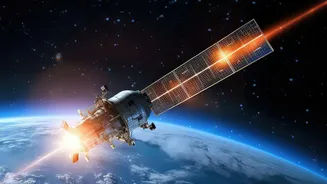
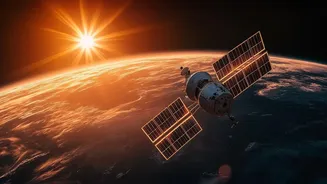
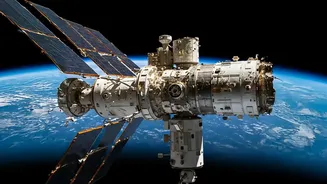
Sending such delicate technology into the harsh environment of space might seem counterintuitive, but it's actually the perfect arena. For quantum communication, space offers a shortcut. Transmitting quantum signals (photons) through Earth's atmosphere over long distances is difficult, but beaming them from a satellite to a ground station is far more efficient. This enables the creation of a secure communication network across vast distances, something impossible with ground-based fibre optics alone. ISRO has already conducted successful ground-based tests, demonstrating free-space quantum communication over 300 metres, a crucial first step towards satellite-based systems. These experiments pave the way for a network that could link different parts of the country, and even connect with other nations, in a completely secure manner.
India's National Quantum Mission
India's ambitions are not just theoretical; they are backed by a concrete plan. In April 2023, the government launched the National Quantum Mission (NQM), an eight-year initiative with a budget of over ₹6,000 crore. The mission aims to foster research and development across the quantum ecosystem, making India a global leader in the field. A major goal of the NQM is to develop satellite-based secure quantum communication between ground stations over a range of 2,000 kilometres within India. This is being driven by institutions like ISRO, the Raman Research Institute, and various IITs, in collaboration with private startups. The plan includes not just communication, but also the development of quantum computers, sensors, and materials.
A Strategic Imperative
So, why the major push? The reasons are primarily strategic. In an age of increasing cyber threats, the ability to create 'future-proof' or unhackable communication channels is a massive national security advantage. This would protect critical infrastructure, from military and defence communications to sensitive financial and government databases. Beyond security, quantum sensors and atomic clocks developed under the mission will enhance the accuracy of India’s own navigation satellite system, NavIC, making it more robust and reliable. This push for self-reliance, or 'Atmanirbhar Bharat', in a critical emerging technology is a key driver, ensuring India does not become dependent on other nations for its security and technological needs.
The Challenges and the Future
The path to quantum supremacy in space is not without its hurdles. The technology is incredibly complex, and the engineering challenges of operating sensitive quantum equipment in orbit are immense. Building a skilled workforce, developing indigenous hardware, and bridging the gap from lab experiments to real-world deployment are significant tasks. However, the commitment is clear. ISRO and other agencies are making steady progress, with successful demonstrations of key components and technologies. Private sector involvement is also growing, with startups beginning to contribute to the ecosystem. By joining the elite group of countries pursuing space-based quantum technology, India is not just participating in a new tech race; it is making a long-term strategic investment in its future as a major space and technological power.