



From Theory to Tangible Asset
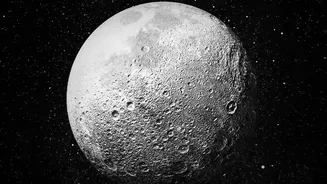
For decades, scientists have theorized that water ice could be trapped in the permanently shadowed craters of the Moon's poles, where temperatures are cold enough to keep it frozen for billions of years. Previous missions, including India's own Chandrayaan-1,
provided the first tantalizing evidence. Now, advanced neutron spectrometer technology has moved beyond theory. These new scans provide high-resolution maps confirming not just the presence of water, but its accessibility. This means the ice is likely mixed within the top layer of lunar soil, or regolith, rather than buried under meters of dense rock, making it a viable resource for extraction.
How a Neutron 'Detective' Finds Water
Finding water from orbit without drilling sounds like science fiction, but it relies on clever physics. The lunar surface is constantly bombarded by high-energy cosmic rays from deep space. These rays smash into the atoms in the lunar soil, knocking particles called neutrons loose. A neutron spectrometer doesn't look for water directly; it counts these escaping neutrons. When neutrons collide with hydrogen atoms—the 'H' in H₂O—they lose a significant amount of energy. An instrument that detects fewer medium-energy neutrons escaping from a specific area is, in effect, seeing a strong signal for the presence of hydrogen below the surface, which is the key indicator for water.
The 'In-Situ' Resource Revolution
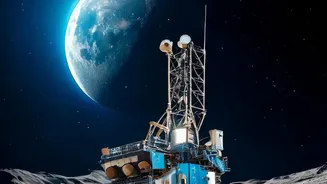
The confirmation of accessible ice is monumental because of what it means for 'in-situ resource utilization' (ISRU)—the ability to live off the land. Launching materials from Earth is incredibly expensive; it can cost millions of dollars to send even a few kilograms into space. Having a local source of water completely changes the economics of space exploration. This ice can be melted for drinking water, and electricity can split the H₂O into oxygen for breathable air and hydrogen for rocket fuel. A lunar outpost could essentially become a self-sustaining base and a refueling station.
Fueling the Future Lunar Economy
This discovery lays the foundation for a true lunar economy. With the ability to produce rocket propellant on the Moon, our satellite could become a launchpad for deeper space exploration. Missions to Mars could refuel at a lunar station, dramatically reducing the mass and cost of the initial launch from Earth. This opens the door for commercial ventures in lunar transportation, resource extraction, and logistics. Companies could specialize in mining and processing this ice, selling water, oxygen, and fuel to various space agencies and private enterprises. The Moon transitions from a destination to a critical piece of infrastructure in our expansion across the solar system.
India's Pivotal Role at the South Pole
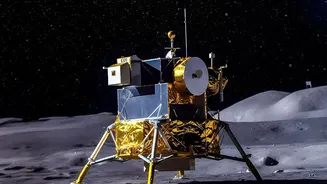
This breakthrough is particularly significant for India. ISRO's Chandrayaan programme has been a pioneer in exploring this very region. India made history by becoming the first nation to successfully soft-land a spacecraft near the lunar south pole with Chandrayaan-3. This strategic focus has positioned the country as a leader in the new moon race, which is less about flags and footprints and more about securing strategic resources. With instruments like the Neutron Spectrometer System being developed for joint missions between ISRO, JAXA, and NASA, India is central to the ground-level verification and eventual utilization of these newly identified ice deposits.