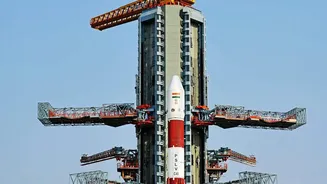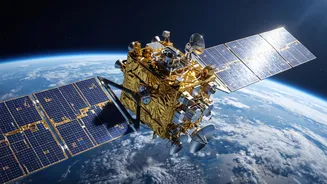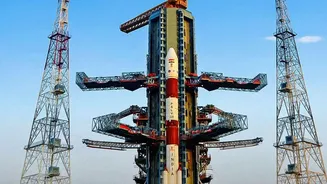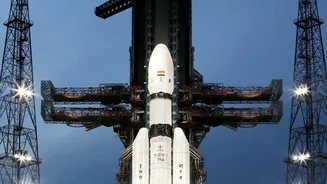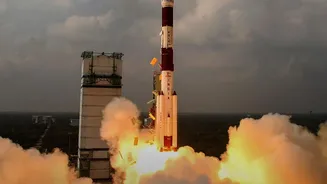



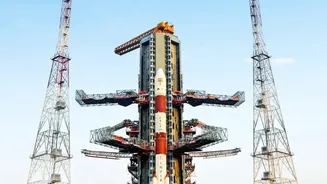


In a significant step towards self-reliance in space technology, India successfully launched its next-generation NVS-03 navigation satellite on October 30, 2026. This mission is a crucial move to strengthen and modernise NavIC, the nation's own satellite navigation system.
What is NavIC?
NavIC, which stands for Navigation with Indian Constellation, is India's indigenous alternative to foreign-owned global navigation systems like the US's GPS. Developed by the Indian Space Research Organisation (ISRO), it's designed to provide reliable positioning, navigation, and timing services across India and a region extending about 1,500 kilometres beyond its borders. The system offers two types of services: a Standard Positioning Service (SPS) for all civilian users and an encrypted Restricted Service (RS) for strategic and military use. The primary motivation for creating NavIC was to ensure India has an independent and sovereign navigation system, a need highlighted during the 1999 Kargil conflict when access to foreign GPS data was reportedly restricted.
A Boost with NVS-03
The successful launch of the 2,250 kg NVS-03 satellite is vital for the NavIC constellation. It aims to ensure the continuity of services, which had faced challenges due to the failure of atomic clocks on some of the older, first-generation satellites. The new NVS series satellites are designed for an enhanced service life of 12 years, an improvement over the 10-year lifespan of their predecessors. With this launch, NavIC is expected to restore its full operational capacity, which requires a minimum of four functional satellites. Before this launch, the system was operating with only three healthy satellites.
Homegrown Tech and Wider Reach
One of the most significant upgrades in the NVS-03 is the inclusion of an indigenously developed Rubidium atomic clock. These clocks are the heart of any navigation satellite, providing the ultra-precise timing needed to calculate a user's location. Failures of imported clocks on earlier satellites prompted India to develop its own, and NVS-03 carries this homegrown technology into orbit, marking a major step toward self-reliance. Furthermore, NVS-03 introduces a new L1 frequency band, which is widely used by consumer devices like smartphones for GPS. This addition is expected to make it much easier for NavIC to be integrated into everyday gadgets, boosting its adoption among the general public.
Why Sovereign Navigation Matters
Having an independent navigation system is a massive strategic asset. It removes dependency on foreign systems that could be denied or degraded during geopolitical conflicts. For the military, NavIC's restricted service provides secure and precise data for guiding munitions, troop movements, and operating defence platforms. Beyond defence, the applications are vast. In disaster management, it can provide early warnings for cyclones and tsunamis and aid in rescue operations. For the economy, it supports critical sectors like transportation, logistics, power grids, and financial transactions that rely on precise timing. The government has already mandated NavIC_based trackers for all commercial vehicles, signalling a strong push for its integration into the national infrastructure.
The Road Ahead for NavIC
While NVS_03 is a crucial milestone, the work to expand and fortify the NavIC system continues. This was the third satellite launched in the new NVS series, and ISRO plans to launch two more, NVS–04 and NVS–05, in 2027 to complete the five–satellite series. The long–term vision is not just to provide a regional service but to build a robust, reliable, and widely–used system that solidifies India's position as a major space power. While NavIC is designed for regional coverage and is not a global system like GPS, it is 'as good as' GPS in terms of accuracy within its service area. As more NavIC–compatible chipsets become available, its presence in civilian life is set to grow, making 'India's own GPS' a common feature for millions.