



A Day Longer Than a Year
The headline isn't an exaggeration; it’s one of the most fascinating facts about our solar system. On Earth, we are used to a simple rhythm: our planet spins on its axis once every 24 hours (a day) and orbits the Sun once every 365 days (a year). Venus
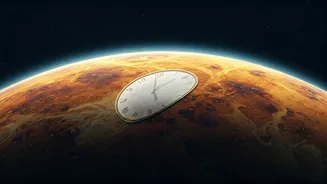
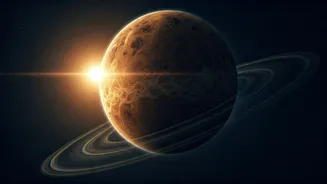
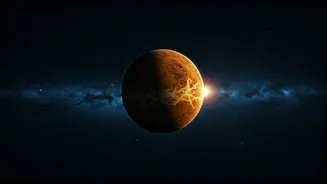
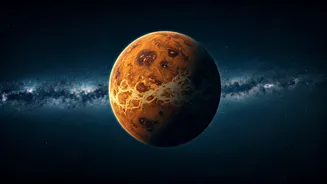
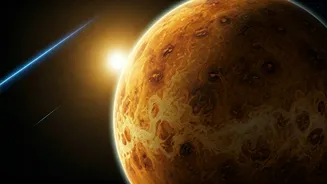
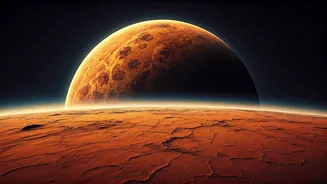
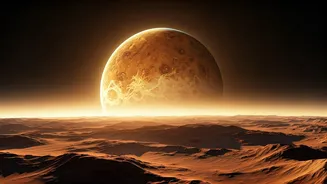
completely flips this script. It completes one full orbit around the Sun in about 225 Earth days, making that the length of a Venusian year. However, it takes Venus a staggering 243 Earth days to complete just one rotation on its axis. This means a single day on Venus is about 18 Earth days longer than its entire year. You would celebrate your first birthday on Venus before you’d even experienced a full day-night cycle from the perspective of the stars.
The Backward Spin Riddle
To make things even stranger, Venus spins backwards. Unlike Earth and most other planets in our solar system, which rotate from west to east, Venus rotates from east to west. This is known as retrograde rotation. If you could stand on the surface of Venus (and survive its crushing pressure and scorching heat), you would see the Sun rise in the west and set in the east. This backward spin has a profound effect on the length of a 'solar day'—the time from one sunrise to the next. Because the planet is rotating in the opposite direction of its orbit, a solar day on Venus is significantly shorter than its rotation period. The time from sunrise to sunrise is about 117 Earth days. So, you’d experience roughly two sunrises and sunsets in a single Venusian year.
Why is Venus So Slow?
Scientists are not entirely certain why Venus has such a peculiar rotation, but there are two leading theories. The first suggests that Venus, early in its history, was struck by a massive asteroid or planetary body. A collision of this magnitude could have been powerful enough to not only slow its rotation to a crawl but also reverse its direction entirely. The second theory is more gradual. It proposes that the planet's incredibly thick and heavy atmosphere, 90 times denser than Earth's, created a powerful 'atmospheric tide.' Over billions of years, the gravitational pull of the Sun on this dense atmosphere could have acted like a brake, slowing down the planet’s spin. This, combined with friction between the planet's core and mantle, might have eventually locked it into its current slow, retrograde state.
Earth's Twisted Sister
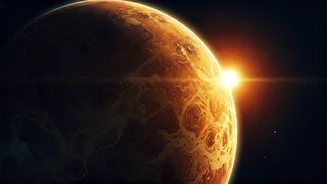
Venus is often called Earth’s 'sister planet' due to their similar size, mass, and composition. But the similarities end there. Venus is a hellscape, featuring a runaway greenhouse effect that traps heat, creating surface temperatures hot enough to melt lead (around 465°C). Its atmosphere is composed almost entirely of carbon dioxide, with clouds of sulfuric acid. Understanding why Venus turned out so differently from Earth is a key priority for planetary scientists. It provides a natural laboratory for studying how planetary atmospheres evolve and what can happen when a greenhouse effect spirals out of control—a cautionary tale that has relevance for our own planet.
Why We Study Our Neighbours
Studying the strange dynamics of planets like Venus is crucial for more than just satisfying our curiosity. It helps us understand the fundamental principles of planetary formation and climatology. By comparing Venus's extreme environment with Earth's, we can refine our models of planetary science and even climate change. For a space-faring nation like India, with ambitions like the Shukrayaan-1 mission to study Venus, understanding these alien worlds is a vital step. Each discovery about our celestial neighbours provides a deeper understanding of our own place in the cosmos and the delicate balance that makes life on Earth possible.