






What is Microgravity, Anyway?
First, let's clear up a common misconception. Microgravity isn't 'zero gravity'. Gravity exists everywhere, even on the International Space Station (ISS). However, because a station is constantly falling around the Earth, astronauts and objects inside
it experience a state of continuous freefall, which creates a feeling of weightlessness. In this environment, fundamental physical phenomena behave differently. Buoyancy and sedimentation, which cause heavier materials to sink and lighter ones to rise on Earth, are virtually eliminated. Convection, the process of heat transfer through fluid movement, also disappears. This unique setting allows scientists to study the underlying nature of materials, biological processes, and chemical reactions without gravity's dominant influence. For India, harnessing this environment is the first step toward building a home in orbit.
India's Experiments in the Void
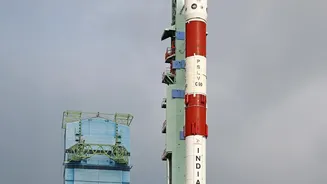
The Indian Space Research Organisation (ISRO) is already laying the groundwork through its Gaganyaan programme, which aims to demonstrate human spaceflight capability. While the initial missions are short-term, they are designed to be platforms for scientific research. ISRO has actively invited the Indian research community to design experiments for this new era. The focus areas are broad, covering materials science, space biology, fluid physics, and even pharmacology. For instance, ISRO is collaborating on experiments aboard international missions to study how microgravity affects everything from the growth of edible microalgae for sustainable food to how astronauts interact with computer screens. Each experiment, no matter how small, is a piece of a much larger puzzle, providing data and operational experience that is impossible to gain on Earth.
The Ultimate Dress Rehearsal
Building a space station is less about a single launch and more about assembling a complex, multi-module structure in orbit while keeping humans alive and productive inside. This is where microgravity research becomes a full-scale dress rehearsal. Studying how fluids behave in space is not just an academic exercise; it's essential for designing the life support systems, fuel lines, and cooling systems of the future Bharatiya Antariksh Station. Research into creating superior metal alloys and crystals in microgravity helps build expertise in in-space manufacturing—a critical capability for producing spare parts or new materials far from Earth. Furthermore, understanding the physiological effects of long-term weightlessness on the human body, such as muscle atrophy and bone density loss, is a primary goal of space medicine research and directly informs how to design a station that keeps astronauts healthy for months on end.
Learning to Live and Work Off-Planet
Beyond the hardware, a space station is a human habitat and a remote workplace. The Gaganyaan missions and associated research are crucial for developing the human expertise needed to operate it. This includes training astronauts not just to fly a spacecraft, but to be on-orbit scientists, technicians, and maintenance crew. It also involves building the vast ground support network required for 24/7 mission control, data analysis, and logistics. Every microgravity experiment hones these operational skills. Ground teams learn to manage complex, remote procedures, troubleshoot problems with significant communication delays, and support the health and well-being of the crew. This institutional knowledge, built over years of incremental experiments, is arguably more valuable than any single piece of technology. It is the foundation of a sustained human presence in space.
The Road to the Bharatiya Antariksh Station
ISRO's roadmap is clear: the Gaganyaan missions are the precursor to the Bharatiya Antariksh Station. The first module of the station is targeted for launch by 2028, with the full five-module station planned to be operational by 2035. This ambitious timeline depends on mastering the technologies and operational protocols being tested today. The research into life support, robotics, and docking technologies for Gaganyaan will directly feed into the station's design. By starting with smaller, manageable microgravity experiments, India is not just collecting scientific data; it is building a pyramid of capabilities. Each successful experiment adds a new layer of confidence, experience, and technical maturity, ensuring that when the time comes to build its orbital home, the nation is ready not just to assemble it, but to truly live and work in it.