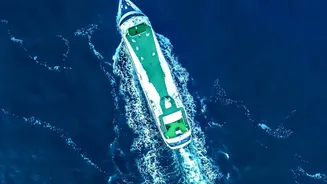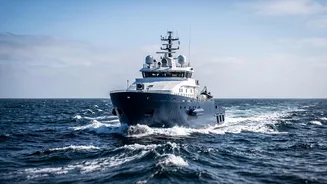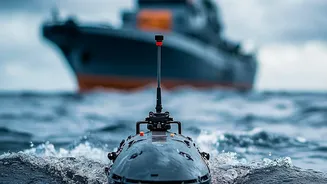






The dream of self-driving ships navigating the world's oceans is closer than ever, but how do you test their AI brains without risking disaster? IIT Madras has an answer: a sophisticated virtual platform called SeaNav.
The Challenge of Unmanned Seas
More than 80% of global trade travels
by sea, making shipping the lifeblood of the world economy. For decades, the industry has relied on human crews to navigate the complexities of open water, crowded ports, and unpredictable weather. Now, the sector stands on the verge of a technological revolution: Maritime Autonomous Surface Ships (MASS). These vessels, powered by artificial intelligence, promise to reduce human error, increase efficiency, and lower operational costs. However, a significant hurdle remains. Testing unproven navigation and control algorithms on a multi-tonne vessel in a busy shipping lane is incredibly expensive, logistically complex, and carries immense risk of collision, grounding, or environmental damage. How can developers ensure an AI captain is ready for the high seas without endangering lives and cargo? This is the critical problem that researchers at the Indian Institute of Technology Madras are tackling.
SeaNav: A Digital Twin for the Ocean
The solution from IIT Madras's Department of Ocean Engineering is SeaNav, which stands for Sea Navigation. It is a real-time 'digital twin' platform—a highly realistic, high-fidelity virtual environment for the maritime world. Built using the powerful Unity3D game engine, SeaNav creates a simulated space where everything from ocean waves and vessel movements to sensor data and complex traffic scenarios can be accurately replicated. Think of it as an incredibly advanced simulator, not just for training humans, but for teaching, testing, and validating the AI systems intended to pilot ships on their own. By creating a virtual proving ground, SeaNav allows developers to push autonomous control systems to their limits in a completely safe and controlled setting, dramatically reducing the cost and risk associated with real-world trials.
How It Works and Why It's a Game-Changer
SeaNav combines digital twin technology with AI, advanced sensor fusion, and virtual reality to create its comprehensive simulation. To ensure the platform mirrors reality, researchers calibrated it using a benchmark model of a 320-meter-long tanker vessel, allowing the results from the virtual world to closely match real-world shipping operations. Within this virtual environment, developers can test how an autonomous system responds to a wide range of challenges. They can simulate a sudden storm, a crowded port approach, or an unexpected maneuver from a nearby vessel. The platform can even support multi-vessel simulations, opening up applications for testing coastal surveillance strategies, coordinating search-and-rescue operations, and even exploring maritime defence scenarios. According to Dr. Suresh Rajendran, an Associate Professor in the Department of Ocean Engineering, this provides a scalable platform where both autonomous systems and human operators can be trained safely and efficiently before ever being deployed in the real world.
Aligning with India's Maritime Vision
The development of SeaNav is not just a technological achievement; it's a strategic one. The platform directly aligns with the Government of India's ambitious 'Sagarmala Programme' and the 'Maritime India Vision 2030'. Both initiatives emphasize the need to invest in smart ports, digital technologies, and autonomous systems to modernize the nation's maritime infrastructure. By fostering indigenous technology like SeaNav, IIT Madras is helping to build India's capacity in a crucial future industry. The platform can be used to develop AI-assisted navigation systems specifically to enhance safety at major Indian ports, including Chennai, Mumbai, Visakhapatnam, and Kochi, helping to reduce the risks of collisions and groundings. Furthermore, by enabling the development of smarter navigation strategies that optimize routes, the technology can help reduce fuel consumption, lower carbon emissions, and minimize the risk of environmental accidents.