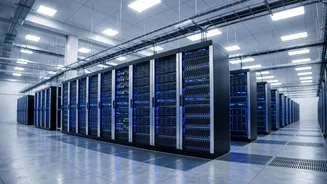







India's digital backbone is set for a massive upgrade. A recent Crisil Ratings report projects the nation's data centre capacity will surge five-fold to 7.5 gigawatts (GW) by 2030, powered by over ₹3 lakh crore in investments. But this explosive growth
isn't guaranteed; it hinges on a critical race to build the required infrastructure.
Decoding the 7.5 GW Target
The projected leap to 7.5 GW from the current operational capacity of around 1.5 to 1.75 GW is monumental. This five-fold increase represents a huge expansion in the physical infrastructure that powers our digital lives. Think of data centres as the engines of the internet; they are secure warehouses packed with servers that store, process, and distribute the data behind everything from streaming movies and online shopping to complex financial transactions and AI-driven applications. This expansion is equivalent to building the digital support system for a rapidly growing economy, capable of handling an unprecedented volume of information generated by millions of users and businesses. The investment, pegged at over ₹3 lakh crore, will flow into construction, high-tech IT equipment, and sophisticated cooling systems, signaling a super-cycle of development for the sector.
The Forces Driving the Data Boom
Several powerful trends are fuelling this demand. The rise of generative artificial intelligence (GenAI) is a primary driver, as AI models require immense computing power that only large-scale data centres can provide. Alongside AI, the widespread digitalisation of Indian enterprises, mass adoption of cloud services, and ever-increasing data consumption from 5G services and Internet of Things (IoT) devices are creating a perfect storm of demand. Furthermore, government policies encouraging data localisation, which require data to be stored within India's borders, are compelling global tech giants, or 'hyperscalers,' to establish or expand their footprint here. This has provided developers with strong revenue visibility, as nearly half of the upcoming capacity is already pre-booked under long-term contracts of 15-20 years.
The Infrastructure Bottleneck
While the demand is clear, the path to 7.5 GW is fraught with significant physical challenges. The most critical bottleneck is power. Data centres are incredibly power-hungry, and the projected growth is expected to put immense strain on local electricity grids. Crisil highlights that about three-quarters of the new capacity will be concentrated in Mumbai, Hyderabad, and Visakhapatnam. By 2030, the data centres in these cities could consume a staggering percentage of their current peak power demand—as high as 80% in Visakhapatnam and 60% in Mumbai. This makes timely grid connectivity and transmission upgrades absolutely essential. Beyond power, developers face hurdles in acquiring large parcels of land in suitable locations, ensuring access to vast quantities of water for cooling systems, and navigating a complex web of regulatory approvals. These timelines are the critical factor that will determine the pace of expansion.
Titans of the Data Centre Race
A mix of domestic conglomerates and global giants are leading the charge to build out India's data infrastructure. Major Indian players like the Adani Group (through its AdaniConneX joint venture), Reliance Jio, and the Hiranandani Group (with Yotta Data Services) are making massive investments. They are joined by established telecom players like Bharti Airtel, which operates Nxtra Data. International heavyweights such as NTT, Equinix, and STT GDC are also expanding aggressively, drawn by India’s structural cost advantages. Development costs in India are notably lower than in competing Asia-Pacific markets, and when combined with competitive power tariffs, result in rental rates that are 30–35% cheaper, giving India a strong competitive edge.