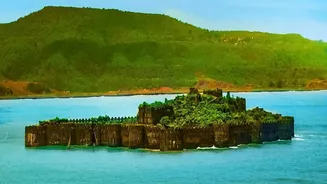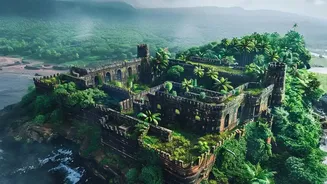



Rising from the Arabian Sea off Maharashtra’s coast, a stone fortress has defied empires and the elements for centuries. This is Murud-Janjira, the unconquered sea fort whose architectural brilliance is a story of survival and ingenuity.
The Unconquered Citadel
Murud-Janjira
is more than just a fort; it is a legend carved in stone. Located on an oval-shaped rock island in the Raigad district, it is famous for being the only fort along India's western coast to have never been conquered by an enemy. Not even the formidable Marathas under Chhatrapati Shivaji Maharaj, nor European powers like the Portuguese, Dutch, and British, could breach its defences. Its name itself hints at its nature, with 'Janjira' believed to be derived from the Arabic word 'Jazira', meaning island. The fort was the stronghold of the Siddis, rulers of African descent who established themselves as a formidable naval power. Originally a smaller wooden structure built by local fishermen in the 15th century for protection against pirates, it was transformed into a massive stone fortress in the 16th century under figures like Malik Ambar of the Ahmadnagar Sultanate, marking its ascent as a strategic powerhouse.
A Masterclass in Defensive Design
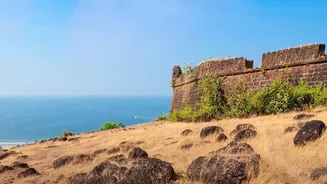
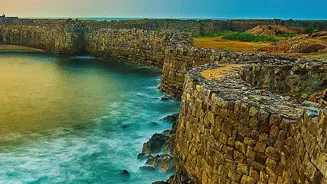
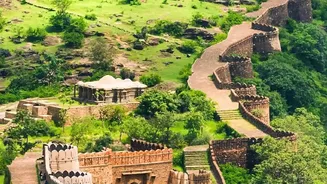
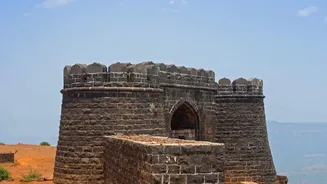
The fort's invincibility is a direct result of its brilliant architectural design. Its 40-foot-high walls seem to rise directly from the sea, especially during high tide, creating a daunting spectacle. The structure is encircled by 19 rounded bastions, which served as platforms for its powerful cannons and provided a panoramic defensive line. One of the most ingenious features is the main entrance. Facing the village of Rajapuri, the gateway is cleverly concealed and only becomes visible when a boat is within a few metres, a design meant to confuse and disorient attackers. For emergencies, a smaller postern gate, known as the 'Darya Darwaza', opened towards the open sea, providing a secret escape route. This combination of camouflage and layered defence made a frontal assault nearly impossible.
The Cannons That Never Fell Silent
A fortress is only as strong as its artillery, and Janjira was armed with some of the most feared cannons of its time. During its peak, the fort reportedly had over 500 cannons. While many have rusted away, several massive cannons remain as a testament to its firepower. Among the most famous are 'Kalalbangdi', 'Chavri', and 'Landa Kasam'. The Kalalbangdi, in particular, was one of India's largest, weighing around 14 tons and capable of firing projectiles over long distances. These cannons, strategically placed upon the numerous bastions, were critical in repelling naval attacks and were a major reason why invading fleets could never secure a foothold.
An Island City Within Walls
Janjira was not just a military outpost but a self-sufficient township designed to withstand long sieges. Inside its formidable walls were all the necessities for a thriving community. Ruins of palaces, quarters for officers and soldiers, stables, and a mosque can still be seen. The most remarkable feat of engineering, however, lay in its water supply. The fort contains two large freshwater lakes, which provided potable water yearrdound despite being surrounded by the saltwater of the Arabian Sea. This, combined with large granaries for storing food, meant the inhabitants could survive for extended periods without needing supplies from the mainland. This self_sufficiency was the secret to outlasting any blockade.