







The High-Stakes Traffic Jam Above Our Heads
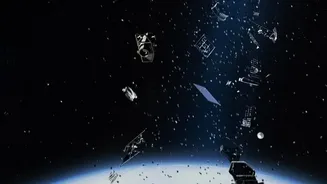
Imagine a highway with more than a million untracked objects, some smaller than a marble, all travelling at over 28,000 kilometres per hour. This isn't science fiction; it's the reality of low-Earth orbit (LEO). Decades of space activity have left behind
a cloud of 'space junk'—defunct satellites, spent rocket stages, and fragments from past collisions. According to NASA, there are over 500,000 pieces of debris the size of a marble or larger. Even a tiny fleck of paint can impact a functioning satellite with the force of a hand grenade, causing catastrophic damage. This orbital traffic jam poses a significant threat to the global economy, which relies on satellites for everything from GPS and weather forecasting to financial transactions and global communications. A 2026 report from the World Economic Forum projected that orbital congestion could cost the industry between $25.8 billion and $42.3 billion over the next decade due to service interruptions and avoidance manoeuvres.
An Ancient Tool for a Modern Problem: The Harpoon
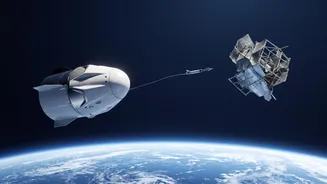
One of the most promising solutions for capturing large, tumbling pieces of debris sounds like something from a classic seafaring novel: the harpoon. Developed by organisations like the European Space Agency (ESA) and Airbus, the concept is straightforward but technically demanding. A 'chaser' spacecraft rendezvous with a target, such as a dead satellite. From a safe distance, it fires a tethered harpoon that penetrates the target's structure. Barbs on the harpoon head deploy to ensure a secure grip. Once attached, the chaser can use the tether to stabilize the tumbling object and then drag it into a lower orbit, where it will safely burn up upon re-entering Earth's atmosphere. The RemoveDEBRIS mission, which launched in 2018, successfully demonstrated a harpoon capture in orbit, proving the fundamental viability of the technology. The primary advantage of the harpoon is its ability to capture a target quickly, making it less sensitive to the object's spin or orientation.
Casting Nets and Using Magnets
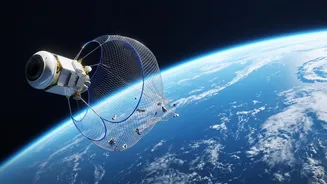
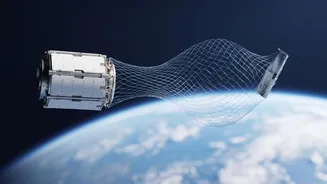
Not all debris is suited for a harpoon. For capturing a wider range of target shapes and sizes, especially those that are more fragile, engineers are turning to nets and magnets. The net concept, also tested on the RemoveDEBRIS mission, involves the chaser satellite launching a large net that unfurls and wraps around the debris. Once ensnared, the combined mass is then de-orbited. The main advantage of the net is its versatility in handling targets with unpredictable shapes or high rotation speeds. Another leading approach uses magnets. The Japanese company Astroscale has pioneered a magnetic docking system with its ELSA-d mission, which successfully launched in 2021. This method requires future satellites to be built with a standardized magnetic docking plate. An 'end-of-life' servicing satellite can then easily latch onto this plate, capture the defunct satellite, and guide it to a fiery end. Astroscale successfully demonstrated this magnetic capture technology multiple times in orbit, marking a significant step towards a commercially viable debris-removal service.
The Emerging Business of Orbital Cleanup
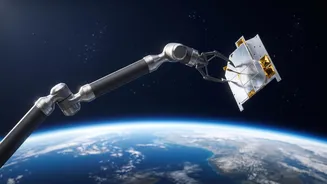
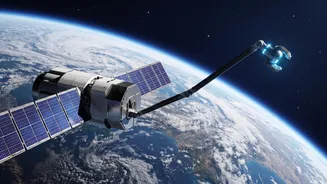
These technologies are not just experimental concepts; they are the foundation of a new commercial space sector focused on Active Debris Removal (ADR) and in-orbit servicing. The ESA has contracted the Swiss startup ClearSpace to launch the first-ever mission to remove an unprepared piece of debris—an old satellite called PROBA-1. The mission, called ClearSpace-1, plans to use a four-armed robotic 'claw' to grab its target and is currently scheduled for launch in 2028 or 2029. The goal is not only to clean up space but to demonstrate the technologies needed to create a sustainable commercial market for these services. Companies like Astroscale are already planning follow-up missions to inspect and eventually remove large pieces of debris, like a Japanese rocket upper stage. The UK Space Agency has also awarded contracts to both ClearSpace and Astroscale to remove defunct British satellites, signalling growing governmental support for this emerging industry.
Beyond Harpoons: The Future of a Cleaner Orbit
While harpoons and nets are designed to capture large objects, other technologies are being developed to tackle the broader problem. One concept is the 'laser broom', a ground-based or space-based laser that would target smaller pieces of debris. The laser beam vaporizes a tiny amount of the object's surface, creating a small thrust that nudges it into a new, lower orbit where it will eventually disintegrate. This non-contact method could be used to manage thousands of small but still dangerous fragments that are impossible to capture with physical systems. Researchers are also exploring advanced electromagnetic systems that can manipulate conductive but non-magnetic objects (like those made of aluminum) from a distance using eddy currents. These innovations highlight a critical shift in the space industry: moving from a 'launch and leave' mentality to one of active stewardship and sustainability, ensuring that key orbits remain usable for generations to come.