




A Tale of Two Telescopes
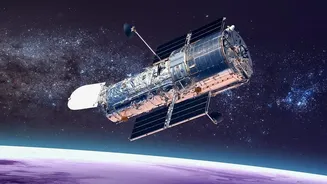
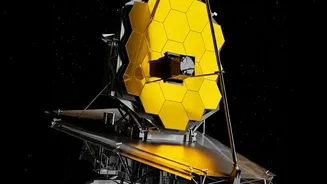
While the headline specifies Hubble, the most groundbreaking recent story of Saturn's atmosphere involves a powerful partnership. The latest insights come from joint observations by the Hubble Space Telescope and the James Webb Space Telescope (JWST).
Hubble, through its long-running Outer Planet Atmospheres Legacy (OPAL) program, provides a consistent, decade-long record of the planet in visible light. This allows scientists to track seasonal changes and the subtle color shifts in Saturn's cloud bands. The JWST, on the other hand, observes in infrared light, which pierces through the hazy upper atmosphere to reveal deeper structures, temperature variations, and chemical compositions. Scientists describe this combined approach as being able to 'slice' through Saturn's atmosphere, revealing it as a connected, three-dimensional system.
Tracking a Planet in Transition
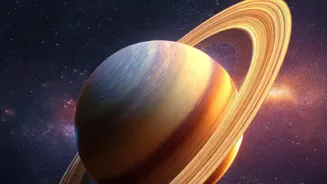
Observations made in 2024 captured Saturn at a critical moment in its 29-year orbit around the Sun. The planet's northern hemisphere, which had been enjoying a long summer, is now tilting away from the Sun as it approaches its equinox in 2025. This transition brings about profound atmospheric changes. Researchers noted a complete reversal of a massive airflow pattern first observed by the Cassini spacecraft. Previously, air rose in the southern hemisphere and descended in the north; now, the flow has flipped, with air rising in the north and flowing south. This has a direct impact on the distribution of atmospheric chemicals like hydrocarbons. This seasonal tracking provides a crucial look at how a gas giant's atmosphere responds to changes in solar heating over many years.
Ghosts of Storms Past
The new infrared views have revealed just how long-lived the consequences of Saturn's mega-storms can be. Webb’s sensitive instruments were able to detect a small spot that is a lingering remnant of the 'Great Springtime Storm' which raged from 2011 to 2012. Even over a decade later, the atmospheric disturbance from that colossal weather event is still visible. Additionally, a long-lived jet stream, nicknamed the 'ribbon wave', can be seen meandering across the northern mid-latitudes. These features, shaped by powerful winds and waves deep beneath the visible cloud tops, confirm that Saturn is a natural laboratory for studying fluid dynamics in extreme conditions.
A Last Look at the Hexagon
Faintly visible in both the Hubble and Webb images is one of the solar system's most bizarre weather patterns: the six-sided jet stream at Saturn's north pole. Known as the hexagon, its persistence for decades has long fascinated scientists. These recent observations are likely to be the last high-resolution look we get at this strange feature until the 2040s. As Saturn's northern pole tilts away from the sun, it will soon enter a winter of 15 years of darkness, hiding the hexagon from our best telescopes. The stability of this massive pattern offers vital clues about the large-scale atmospheric processes that govern giant planets.
An Unexpected Ring Connection
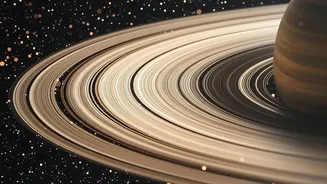
Beyond the seasonal changes, other Hubble data has pointed to an even more surprising weather influence: the rings themselves. A separate study combining decades of ultraviolet (UV) observations from Hubble and other missions found that icy particles raining down from Saturn's rings are heating its upper atmosphere. This 'ring rain'—potentially caused by micrometeorite impacts or interactions with the solar wind—creates an excess of hot hydrogen in the atmosphere. This unexpected interaction demonstrates that the rings are not just a static decoration but an active component of Saturn's wider environmental system, directly influencing the planet's weather and atmospheric chemistry.