




A New Partner in Cosmic Discovery
Set to launch by late 2026, NASA's Nancy Grace Roman Space Telescope is not a replacement for Hubble, but a powerful new partner. Named after NASA's first chief of astronomy, Roman shares a key feature with its famous predecessor: a 2.4-meter primary
mirror. However, this is where the similarities largely end. Roman is engineered for breadth, designed to survey vast swathes of the sky with incredible speed and efficiency. Its primary mission is to tackle some of the biggest questions in astrophysics, including the nature of dark energy and the census of planets beyond our solar system. While Hubble zooms in on specific targets with exquisite detail, Roman will zoom out, creating enormous cosmic maps that will help scientists understand the universe on the grandest of scales.
The Power of a Panoramic View
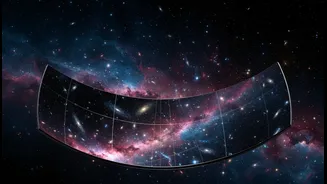
The crucial difference between the two telescopes is Roman's Wide Field Instrument (WFI). This advanced camera gives Roman a field of view at least 100 times greater than Hubble's infrared instruments. To put that in perspective, where Hubble might need hundreds of individual images to map a small patch of a nearby galaxy, Roman could capture a similar area in just a couple of shots. This panoramic capability means Roman will image more than 50 times the amount of sky that Hubble has in its entire 30-plus years of operation, and it will do so in just its first five years. One scientist noted that a single month of observation time with Roman could be equivalent to a century on Hubble in terms of data collection for large surveys.
Mapping the Universe's Invisible Architecture
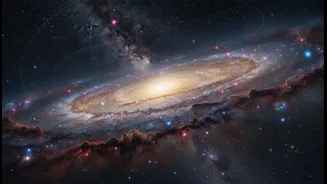
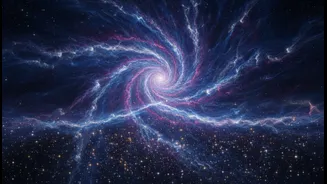
So, what are the "cosmic patterns" Roman is expected to find? Its wide, deep surveys are perfectly suited to mapping the large-scale structure of the universe. This includes the cosmic web—vast, interconnected filaments of galaxies and dark matter separated by immense, nearly empty regions known as cosmic voids. By observing the distribution and shapes of billions of galaxies, Roman will help scientists probe the influence of dark matter, the invisible substance that provides the gravitational scaffolding for cosmic structures. Furthermore, these maps will provide crucial data on dark energy, the mysterious pressure causing the expansion of the universe to accelerate. By studying how these large structures have evolved over cosmic time, astronomers hope to finally get a handle on the forces that govern the universe's destiny.
A New Frontier for Planet Hunting
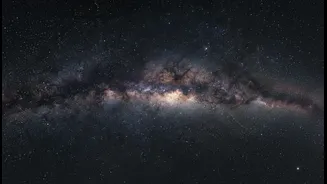
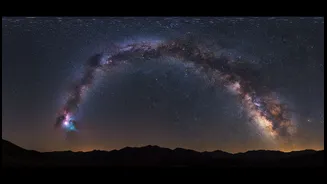
Beyond cosmology, Roman's wide view will revolutionize the hunt for exoplanets. Instead of staring at one star at a time, Roman will monitor hundreds of millions of stars toward the dense central bulge of our Milky Way galaxy. It will use a technique called gravitational microlensing, where the gravity of a star and its planets can magnify the light of a more distant background star. This method is sensitive enough to find planets with masses similar to Earth's and even smaller, including worlds that orbit far from their star or are rogue planets wandering through space alone. Scientists anticipate Roman will discover thousands of new exoplanets, providing a massive new dataset to understand how common solar systems like our own truly are.