

The 'Goldilocks' Misconception
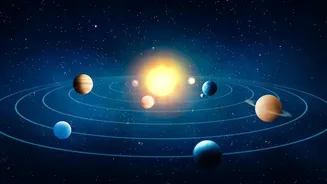
The habitable zone is the orbital region around a star where a planet's surface could theoretically support liquid water. It’s a simple, powerful concept that helps astronomers narrow down which of the thousands of known exoplanets are the most promising
candidates for life. If a planet is too close to its star, its water will boil away; too far, and it will freeze solid. But as we've learned more about planetary systems, it has become clear that this is an oversimplification. Location is crucial, but it's not the only ingredient. A planet's individual characteristics can create wildly different outcomes, turning a potential paradise into a scorching wasteland or a frozen ice ball, even with a perfect address.
Our Local Example: Earth vs. Venus
We don't need to look to distant star systems to see this principle in action. Venus and Earth are often called sister planets due to their similar size and mass. Both orbit within or near the Sun's habitable zone. Yet, they could not be more different. Earth is a vibrant world teeming with life, while Venus is the hottest planet in our solar system, with surface temperatures that can melt lead. Its atmosphere, almost entirely carbon dioxide, is 90 times denser than Earth's, creating a runaway greenhouse effect that incinerated any ancient oceans. This stark contrast shows that being in the right zone is just the start; a planet’s atmospheric evolution is a major fork in the road to habitability.
Atmosphere: A Planet's Climate Control
A planet's atmosphere is its most critical feature for regulating temperature. Its composition and density determine how much heat is trapped. Earth’s atmosphere has enough greenhouse gases to keep our planet warm, but not so much that it overheats. Venus, on the other hand, is a cautionary tale of what happens when this balance is lost. Furthermore, a planet needs to be massive enough to hold onto its atmosphere. Smaller worlds like Mars have a much thinner atmosphere because their weaker gravity couldn't prevent gas from escaping into space over billions of years. This left it with little insulation against the cold of space.
Size, Shielding, and Inner Heat
A planet’s size and composition do more than just determine its gravity. A molten iron core, like Earth's, can generate a global magnetic field. This invisible shield is vital, as it deflects harmful solar wind and radiation that would otherwise strip away the atmosphere and any surface water. Venus, despite its similar size, lacks a significant internally generated magnetic field, leaving its upper atmosphere exposed. Furthermore, a planet's internal heat can drive geological activity like plate tectonics. This process is believed to be important for long-term climate stability on Earth, acting as a planetary thermostat by recycling carbon between the atmosphere, oceans, and crust. Venus appears to lack this Earth-style plate tectonics, contributing to its static, hellish environment.
The Temperament of a Star
Not all stars are created equal. The type of star a planet orbits dramatically affects its potential for life. Our Sun is a relatively stable G-type star. More common in the galaxy are red dwarfs, which are smaller and cooler. Their habitable zones are much closer to the star, which can be a problem. Planets in these tight orbits can become tidally locked, with one side in permanent daylight and the other in endless night. They are also often blasted by intense flares of X-ray and UV radiation, which can be hundreds of thousands of times stronger than what Earth receives, potentially sterilizing the surface and eroding the atmosphere. Conversely, stars much larger and hotter than the Sun have shorter lifespans, possibly not long enough for complex life to evolve.