

It’s An Illusion, Not Physics
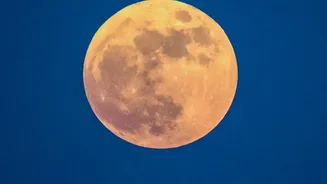
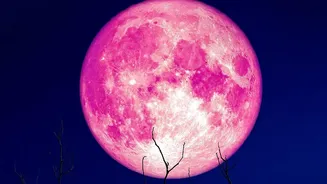
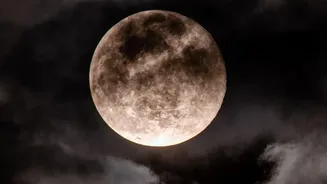
First, let's clear up a common misconception. The Moon, Sun, or constellations are not physically larger or closer when they're near the horizon. In fact, the Moon is slightly farther away from you when it's on the horizon compared to when it's directly
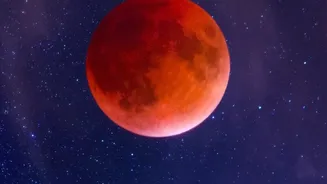
overhead. The change in colour to a reddish or orange hue is a real atmospheric effect caused by light scattering, but the size enlargement is purely a trick of the mind. This powerful and convincing phenomenon, known for thousands of years, is called the Moon illusion, and it applies to any celestial object viewed in the same context.
The Apparent Distance Hypothesis
The most widely accepted explanation is the 'apparent distance hypothesis'. This theory suggests our brains are wired to perceive the sky as a flattened dome, not a perfect hemisphere. We think of the sky directly above us as being relatively close, while the horizon seems incredibly far away. Our brains are used to seeing objects on the horizon, like trees, mountains, and buildings, which provide depth cues. When the Moon or Sun appears in this 'distant' part of the sky, our brain registers it as being very far off.
Enter the Ponzo Illusion
This is where another famous optical illusion comes into play: the Ponzo illusion. Imagine two identical lines drawn on a set of converging railway tracks. The line drawn where the tracks are closer together appears longer than the one where they are farther apart, because our brain assumes it must be larger to take up the same space at a greater distance. The same logic applies to the sky. Since the Moon on the horizon is perceived as being farther away (due to all the landscape cues), yet it has the same angular size as the Moon overhead, our brain concludes it must be enormous.
Sunrises and Sunsets Get the Same Treatment
This is not just a lunar phenomenon. The Sun is subject to the exact same mental calculation. When you watch a sunrise or sunset, the Sun is positioned against the same terrestrial reference points—hills, the sea, a city skyline. Your brain uses these cues to judge the Sun as being very distant and therefore scales up its perceived size to compensate. When the Sun is high in the sky at noon, there are no reference points next to it. It's just a bright disc in a vast, empty expanse, so our brain doesn't receive the same signals to enlarge it.
Even Constellations Stretch Out
The effect on constellations is more subtle but follows the same principle. While individual stars are just points of light, the perceived space between the stars in a constellation can appear to stretch when near the horizon. For example, a familiar pattern like Orion or the Big Dipper might seem to take up a much larger patch of sky when it's rising or setting compared to when it's high overhead. Your brain is again interpreting the star pattern as being on that 'distant' part of the flattened sky dome, and thus perceives its dimensions as being grander.