






The Planet's Climate Regulator
For decades, we’ve known the ocean is a critical buffer against climate change. It has absorbed more than 90% of the excess heat and over a quarter of the carbon dioxide (CO2) emitted by human activities since the industrial revolution. Without this vast
reservoir, our atmosphere would be significantly hotter. This process is largely driven by two key mechanisms. The first is the 'solubility pump', where cold, dense water at the poles dissolves CO2 from the atmosphere and sinks, carrying it to the depths. The second is the 'biological carbon pump', a complex process where microscopic marine plants called phytoplankton consume CO2 at the surface. When these organisms die, they sink, carrying that carbon with them into the deep sea, where it can be stored for hundreds or even thousands of years.
A New Frontier of Discovery
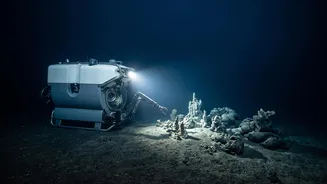
Historically, the deep sea—defined as waters below 200 meters—has been incredibly difficult to study. However, a new generation of technology is changing that. An international fleet of nearly 4,000 robotic 'Argo floats' now patrols the upper 2,000 meters of the ocean, measuring temperature and salinity. More recently, 'Deep Argo' floats are being deployed to reach depths of up to 6,000 meters, opening up the full ocean volume to observation for the first time. These autonomous probes, along with advanced submersibles and remote sensing, are providing a torrent of new data from this previously hidden world, revealing processes that are faster and more complex than ever imagined.
Turbulence and Tidings from the Deep
One of the most startling recent findings is the role of small-scale, deep-ocean turbulence. Previously, scientists believed that the mixing of heat, carbon, and nutrients between the deep sea and the surface occurred over thousands of years. However, a July 2026 study in Nature Communications revealed that these processes can happen within a single human lifetime. Tiny, coin-sized swirls of water, far from being insignificant, are powerful drivers of this exchange. This discovery has profound implications. It affects everything from the rate at which polar ice melts to the intensity of storms and the stability of marine food chains that rely on nutrients upwelling from the deep. Researchers are also finding unexpected sources of food for deep-sea microbes, such as nutrients being squeezed out of sinking organic particles by immense pressure, which could reshape our understanding of the deep ocean's carbon cycle.
Challenging Our Climate Models
These new findings present a major challenge for existing climate models. Current models, which inform global climate policy, may not accurately capture the speed and scale of these deep-ocean dynamics. For instance, the research on turbulence showed that climate models often deviate significantly from observational data, suggesting they may be underestimating the rate of change. Understanding the biological pump with greater accuracy is also critical. Knowing precisely how much carbon is being sequestered, and for how long, is essential for predicting the future trajectory of atmospheric CO2 levels. As scientists refine their understanding of these deep-sea processes, climate models will become more accurate, giving us a clearer picture of the challenges ahead.
Why the Deep Sea Matters for India
For a nation like India with a vast coastline of over 7,500 kilometres, these discoveries are not just academic. The Indian Ocean, much of which is deep sea, plays a crucial role in regulating the monsoon, the lifeblood of the subcontinent's agriculture and economy. Changes in ocean heat distribution and currents can directly influence monsoon patterns, potentially leading to more extreme weather events. Furthermore, a better understanding of how the ocean absorbs heat and carbon is vital for predicting sea-level rise, a direct threat to coastal cities like Mumbai, Chennai, and Kolkata. The health of marine ecosystems, which support the livelihoods of millions in India, also depends on these deep-sea nutrient cycles. As our knowledge of the deep ocean grows, so too does our ability to forecast and adapt to the regional impacts of a changing climate.