




Chasing a Cosmic Ghost
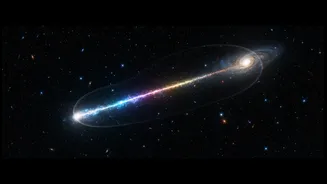
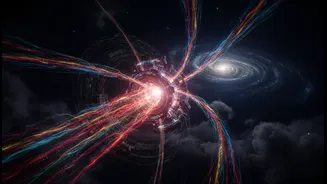
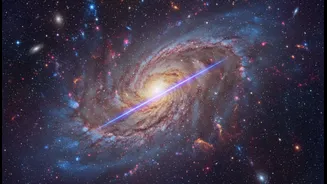
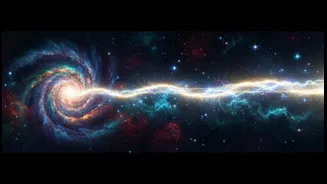
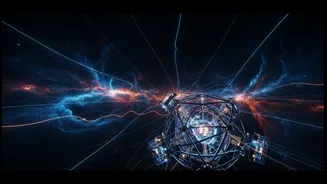
In September 2021, a high-energy neutrino struck the IceCube Neutrino Observatory at the South Pole. Dubbed IC 210922A, this single, almost massless particle carried immense energy after travelling for 11 billion years. Neutrinos are famously elusive;
they pass through most matter without a trace, earning them the nickname 'ghost particles.' Detecting one with such high energy is rare, and immediately triggers a global hunt to find its origin. Initially, astronomers scanned the sky in visible light, X-rays, and gamma rays, but found no obvious source like an exploding star or a feeding supermassive black hole. The trail went cold.
Meet the 'Shadow Blaster'
The breakthrough came when astronomers used telescopes sensitive to submillimeter wavelengths, which can detect cold dust and gas. There, they found a galaxy, officially JCMT0402−0424, that was incredibly bright at these wavelengths but nearly invisible in optical light. Due to its hidden, powerful nature, the team nicknamed it the 'Shadow Blaster.' For years, the prime suspects for creating high-energy neutrinos were blazars—galaxies with supermassive black holes shooting jets of particles towards Earth. But the Shadow Blaster showed no signs of such a black hole. The source of its energy was a complete surprise.
A Lens Made of Gravity
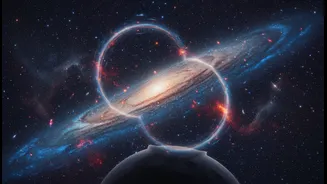
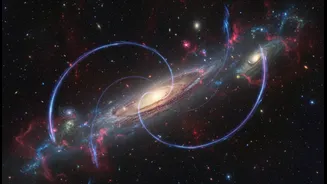
Observing a galaxy so distant and dust-shrouded would normally be impossible. However, a fortunate cosmic alignment made it visible. A massive foreground galaxy sits directly between Earth and the Shadow Blaster, and its immense gravity bends and magnifies the light from the more distant galaxy. This phenomenon, known as gravitational lensing, acts like a natural telescope, providing a detailed view that would otherwise be out of reach. The lensed images revealed the Shadow Blaster not as a single point of light, but as distorted golden arcs. This cosmic magnifying glass allowed scientists to probe the galaxy's core and discover what was truly powering it.
A Different Kind of Engine
Instead of a central black hole, the detailed observations revealed that the Shadow Blaster is a 'starburst' galaxy, a cosmic factory churning out new stars at a furious rate. The galaxy’s energy comes from this intense star formation within a very dense, gas-rich core. Scientists now believe this violent, compact environment is what accelerated the neutrino to such high energies. In these dense regions, cosmic rays—other high-energy particles—slam into the surrounding gas and dust, producing a shower of particles that includes neutrinos. This finding provides the first strong evidence that extreme star formation, not just black holes, can create these powerful ghost particles.
Why This Discovery Matters Now
The discovery of the Shadow Blaster is significant because it helps solve a long-standing puzzle. The IceCube observatory detects a steady background of high-energy neutrinos coming from all directions in the sky, and previously identified sources like blazars could not account for all of them. This new finding suggests that dusty, hidden star-forming galaxies, which were common in the early universe, could be a major and previously unknown contributor. Researchers estimate this population of galaxies could be responsible for up to 20% of the cosmic neutrino background measured by IceCube. It opens a new window into the most extreme processes in the cosmos and demonstrates the power of 'multi-messenger' astronomy—using different signals like light and particles to piece together a more complete picture of the universe.