




A Cosmic Collision Site
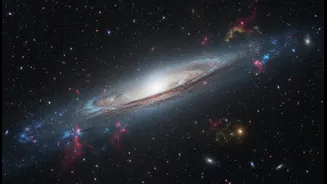
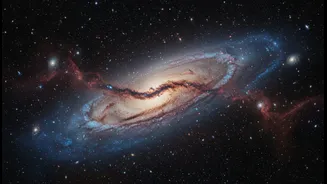
Centaurus A is not your average galaxy. Located about 11 to 13 million light-years away, it's one of the closest active galaxies to Earth. For decades, astronomers have been fascinated by its peculiar shape: a giant elliptical galaxy sliced through by a thick,
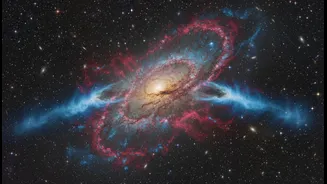
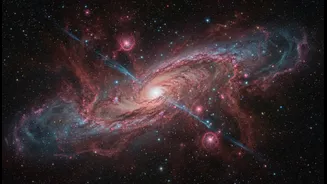
dark lane of dust. This unusual structure is strong evidence of a dramatic history. Scientists theorise that roughly two billion years ago, a large elliptical galaxy collided with and consumed a smaller spiral galaxy. This ancient crash left behind the warped disk of gas and dust we see today and triggered waves of intense star formation, making Centaurus A a perfect laboratory for studying how galaxies evolve through mergers.
Webb's Infrared Advantage
Previous telescopes like Hubble have given us beautiful images of Centaurus A, but their view was incomplete. The thick dust lanes that make the galaxy so distinctive also act like a cosmic curtain, blocking visible light and hiding the galaxy's core from view. This is where the James Webb Space Telescope (JWST) changes the game. Webb is designed to see the universe in infrared light, which can pass through dense clouds of dust that obscure other wavelengths. While the retired Spitzer Space Telescope could also see in infrared, it lacked the power to resolve fine details. Webb's unprecedented sensitivity and sharpness allow it to peel back those dusty layers and reveal the galaxy's inner workings with stunning clarity, star by star.
An Exercise in Galactic Archaeology
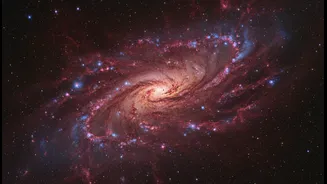
The new image is a treasure trove of information, allowing for what scientists call 'galactic archaeology.' What looks like a grainy texture in the image is actually a dense field of millions of individual stars. By observing these stars, astronomers can start to build a timeline of the galaxy's life. Webb can help distinguish between different generations of stars: the older ones that existed before the collision, a burst of new stars formed during the merger, and younger stars born from the gas stirred up in the aftermath. Each star is a fossil record, helping to reconstruct the galaxy's dramatic history and confirm that a major merger event shaped the Centaurus A we see today.
Feeding a Central Monster
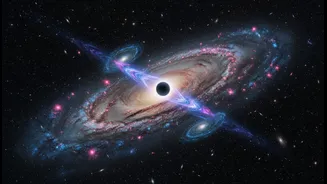
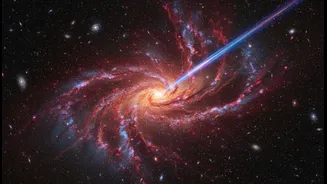
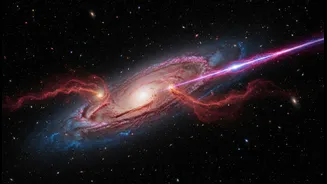
At the heart of Centaurus A lies a supermassive black hole, one that is actively feeding on the surrounding gas and dust supplied by the long-ago merger. As material falls into the black hole, it unleashes enormous amounts of energy, launching powerful jets of high-speed particles far into space. Webb's new view reveals intricate new details about this process. The MIRI (Mid-Infrared Instrument) has exposed glowing, intricate shapes and wisps of warm dust, including a mysterious 'S' shaped feature near the core. These structures show how the black hole's activity shapes the galaxy around it, sometimes compressing gas to trigger new star birth and other times blowing it away, effectively stunting growth.
A Glimpse into Our Own Future?
Studying galactic collisions like the one that formed Centaurus A isn't just about understanding the distant past; it could also be a preview of our own cosmic destiny. The Milky Way is on a collision course with our nearest large galactic neighbour, the Andromeda galaxy. While that cosmic smash-up is still billions of years away, observing Centaurus A gives us a front-row seat to the kinds of processes that will eventually unfold. Galactic mergers are a fundamental part of how the universe is structured, driving the evolution of galaxies and the supermassive black holes at their centres. The detailed new portrait of Centaurus A provides a clearer picture than ever of this violent, creative, and essential cosmic dance.