




A Land of Thirst and Innovation
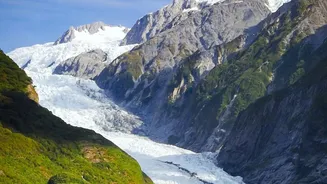
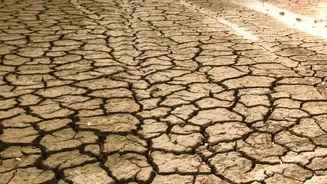
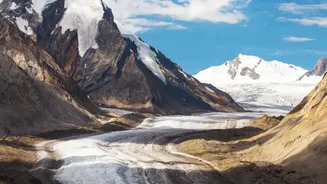
Ladakh's survival has always depended on a delicate balance with its harsh environment. With less than 100mm of annual rainfall, communities have traditionally relied on the seasonal melt of Himalayan glaciers to irrigate their fields of barley and vegetables.
But climate change is disrupting this ancient rhythm. Glaciers are receding and the winter snow melts too early, while the crucial glacial meltwater arrives too late in the spring for the sowing season. This creates a dangerous water gap in April and May, threatening the livelihoods of a population where around 80% of people are farmers. Faced with this existential threat, a remarkable solution has emerged from within the community itself, blending ancient knowledge with modern engineering.
Enter the Ice Stupa
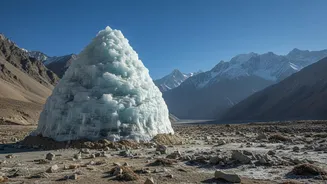
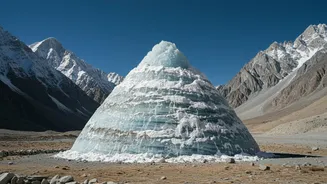
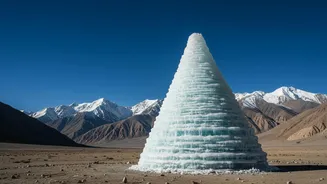
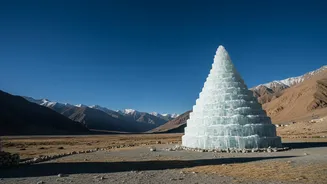
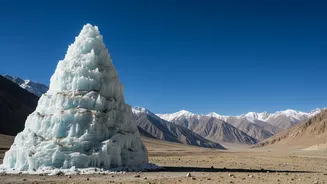
The innovation is the 'ice stupa,' an artificial glacier shaped like the iconic conical Buddhist monuments that dot the Ladakhi landscape. The concept was pioneered in 2013 by local engineer and innovator Sonam Wangchuk, who sought a more effective way to store winter water that would otherwise flow away unused. Earlier attempts at creating artificial glaciers were horizontal and melted too quickly under the sun. Wangchuk's insight was to build vertically. He realized that a conical shape exposes the minimum possible surface area to direct sunlight for the maximum volume of water stored, significantly slowing the melting process. This allows the frozen reservoir to last well into the warmer months, releasing water precisely when it is needed most.
The Science of Simplicity
The genius of the ice stupa lies in its elegant simplicity. The system works without any electricity or pumps, relying solely on gravity. A pipeline is laid from a glacial stream at a higher altitude, carrying water down to the village. Due to the elevation difference, water pressure naturally builds. The pipe leads to a vertical sprinkler that shoots water high into the freezing winter air, where temperatures can plummet below -30°C. As the fine spray falls, it freezes almost instantly, layer by layer, over a basic support structure of branches and ropes. Throughout the winter, this process builds a towering cone of ice, some reaching over 30 meters high and storing millions of litres of water. The first prototype, a modest 6-meter structure holding 150,000 litres, proved the concept by lasting until mid-May.
A Lifeline for Communities
The impact has been transformative. The stored water begins to melt in the spring, providing a steady supply for irrigation during the critical sowing season. This has enabled farmers to cultivate their crops on time, securing food supplies and boosting local economies. During the project's inauguration in 2015, villagers planted over 5,000 saplings using water from an ice stupa, turning a barren patch of desert green. The initiative, run by Wangchuk's Students' Educational and Cultural Movement of Ladakh (SECMOL) and later the Himalayan Institute for Alternative Ladakh (HIAL), has scaled significantly. Dozens of ice stupas have now been built across Ladakh, with the concept also being adopted in other mountain regions globally, including Switzerland and Peru.
Challenges and the Future
Despite their success, ice stupas are not a simple fix. Their construction is labour-intensive and requires significant community participation. One of the main technical challenges is preventing the supply pipes from freezing solid in extremely cold weather, which can halt the stupa's growth. To address this, innovators are now developing automated systems that use weather data to adjust water flow, making the process more efficient and reliable. While initially met with some skepticism, the worsening water shortages have made ice stupas an essential adaptation tool. They are seen not just as a water source, but as a powerful symbol of local resilience and a proactive response to the climate crisis.