
The ultimate fate of our planet is tied to the life of our star. While headlines can spark fears of cosmic doom, recent research confirms that Earth isn't in any immediate danger from the Sun's eventual, and very distant, demise.
Our Sun Today: A Stable Star
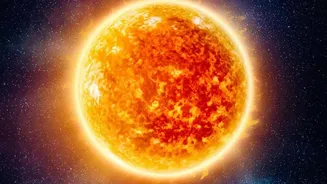
Right now, our Sun is
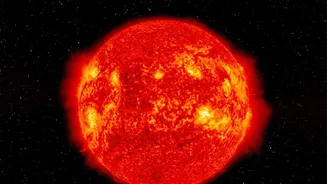
in the most stable phase of its life, known as the 'main sequence'. For the last 4.6 billion years, it has been steadily fusing hydrogen atoms into helium in its core, releasing a predictable and life-sustaining amount of energy. This process is what warms our planet, drives our climate, and powers photosynthesis. Scientists predict the Sun is a little less than halfway through this phase and will remain a stable yellow dwarf star for about another 5 billion years. During this time, it provides the reliability needed for life to flourish. However, it is not perfectly static; the Sun is gradually getting brighter, a change that will have consequences long before its final act begins.
The First Sign of the End: A Billion-Year Warning
The first 'imminent' threat is still incredibly far off. As the Sun continues to burn through its hydrogen, its luminosity increases by about 10% every billion years. In approximately one billion years, this increased radiation will be intense enough to trigger a 'moist greenhouse' effect on Earth. The oceans will begin to evaporate at an accelerated rate, loading the atmosphere with water vapour, which traps more heat and creates a runaway feedback loop. This will render Earth's surface completely uninhabitable for complex life, long before the Sun itself begins to dramatically expand.
The Red Giant Phase: A Cosmic Tug-of-War
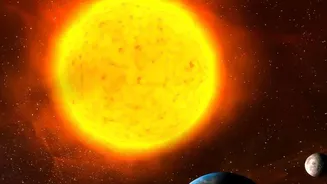
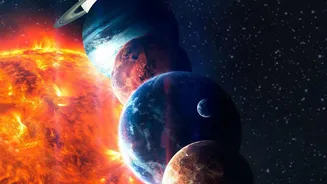
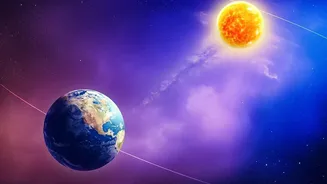
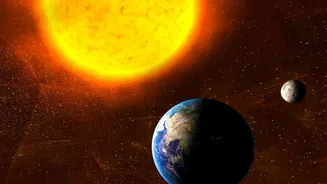
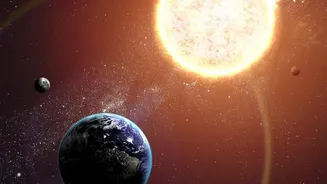
In about 5 billion years, the Sun will finally exhaust the hydrogen fuel in its core. Without the outward pressure from fusion, gravity will cause the core to contract and heat up. This intense heat will ignite hydrogen fusion in a shell surrounding the core, causing the Sun's outer layers to expand dramatically. It will swell into a red giant, becoming hundreds of times its current size. During this phase, it will certainly engulf the innermost planets, Mercury and Venus. Earth's fate, however, is less certain and depends on a delicate cosmic balance. As the Sun expands, its tidal forces will pull Earth inward. At the same time, the Sun will be shedding huge amounts of its mass through powerful stellar winds. This mass loss weakens its gravitational grip, which could allow Earth's orbit to drift safely outward.
Will Earth Be Swallowed?
For decades, most models predicted that Earth would be consumed. However, more recent studies from 2026 using updated calculations suggest there's a chance our planet could survive being engulfed. These models indicate that the tidal forces pulling Earth inward may be weaker than previously thought, potentially allowing our planet to migrate to a wider, safer orbit as the Sun loses mass. Still, scientists stress that this outcome is far from guaranteed. The key variable is how quickly the Sun sheds its mass during its final giant phases, an aspect of stellar evolution that is still not perfectly understood. But even if the planet itself survives, it would be a scorched, lifeless rock with a molten surface.
The Final Act: A White Dwarf
After its red giant phases, the Sun won't have enough mass to explode in a supernova. Instead, its outer layers will drift away, creating a beautiful, glowing shell of gas called a planetary nebula. Left behind will be the Sun's incredibly hot, dense core: a white dwarf. This stellar remnant will be about the size of Earth but contain roughly half the Sun's original mass. With no fuel left to burn, the white dwarf will simply cool and fade over trillions of years, eventually becoming a cold, dark 'black dwarf'. Any surviving planets, including a potentially roasted Earth, would continue to orbit this dying ember in a cold and dark solar system.