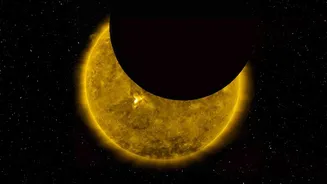



A Priceless Glimpse of the Corona
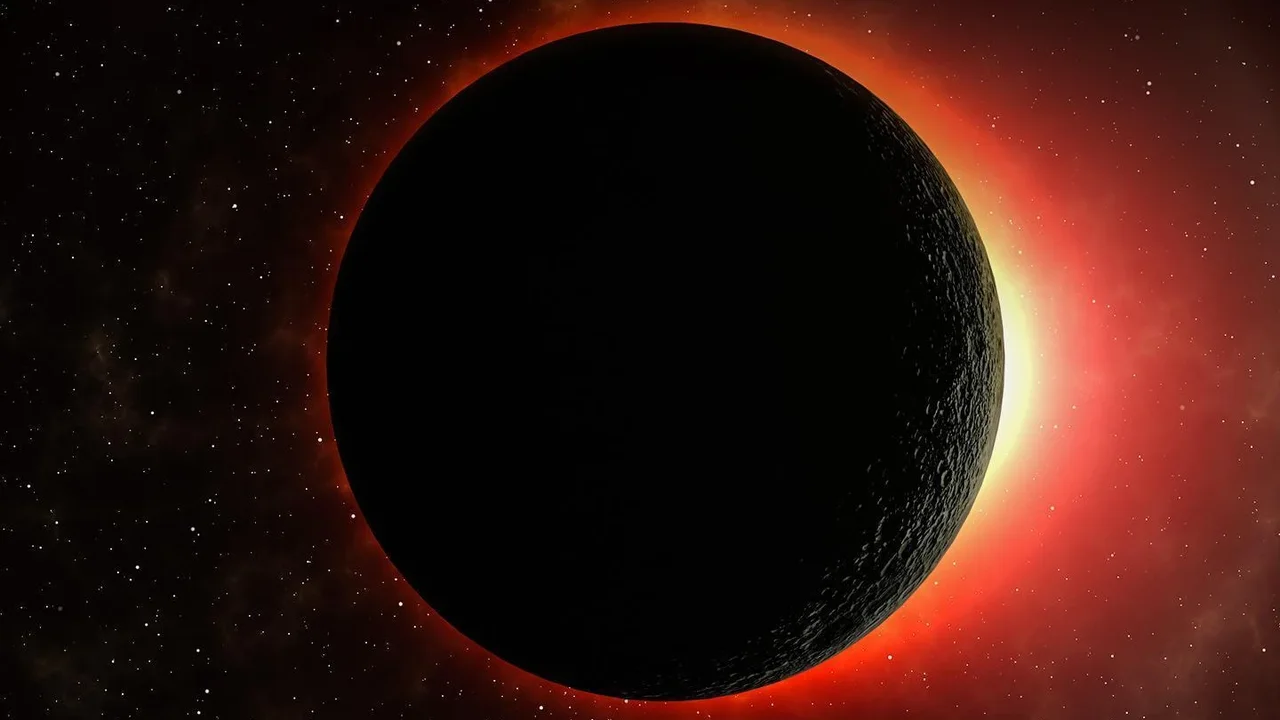
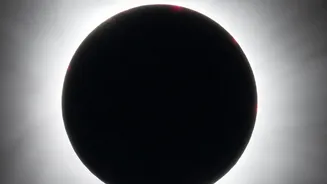
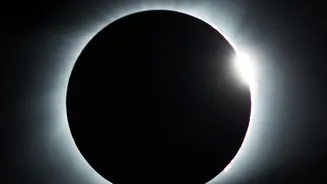
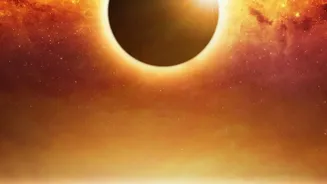
The main reason scientists get so excited about a total solar eclipse is that it provides a rare and unobstructed view of the sun's outer atmosphere, the corona. This wispy, superheated plasma is usually invisible, completely washed out by the blinding
light of the sun's surface. During totality, the moon acts as a perfect natural shield, revealing the corona's ethereal glow. While scientists have instruments called coronagraphs that can create an artificial eclipse, they can't match the clarity provided by the moon. The moon's sharp edge prevents the diffraction of light that plagues man-made instruments, allowing for a much clearer view of the corona's inner regions, where many of its mysteries are born.
Solving the Sun's Greatest Mysteries
Observing the corona is key to solving some of the most fundamental questions about our star. One of the biggest puzzles is the coronal heating problem: the corona is hundreds of times hotter than the sun's surface below it, reaching temperatures over a million degrees Celsius, which defies simple explanation. Eclipses allow scientists to gather data on the magnetic fields and plasma structures that may hold the key to understanding how this intense heat is generated and transferred. This research is also crucial for understanding space weather. The corona is the source of the solar wind and explosive events like coronal mass ejections (CMEs), which can disrupt satellites, power grids, and communication systems on Earth.
Testing the Fabric of the Universe
Historically, solar eclipses have been used for more than just studying the sun; they’ve helped reshape our understanding of the entire universe. The most famous example occurred in 1919, when a total solar eclipse provided the first experimental proof of Albert Einstein's theory of general relativity. Einstein predicted that the sun's immense gravity would bend the fabric of spacetime, causing the light from distant stars to appear shifted from their normal positions. This effect is impossible to measure normally because the sun's brightness obscures nearby stars. During the 1919 eclipse, astronomers Arthur Eddington and Frank Dyson photographed the stars around the blotted-out sun and confirmed that their light was indeed bent, validating Einstein's revolutionary theory and making him a global icon.
A Legacy of Discovery
Eclipses have a long history of enabling scientific breakthroughs. In 1868, observations of a solar eclipse led to the discovery of a new element. While studying the spectrum of light from the sun's chromosphere—a layer visible just before totality—French astronomer Pierre Janssen noticed a yellow line that didn't correspond to any known element on Earth. This new element was fittingly named helium, after Helios, the Greek god of the sun. It was only identified on Earth years later. This and other discoveries have cemented the solar eclipse as an indispensable natural laboratory for astronomers.
What's in Store for August 2026?
For the August 12, 2026, eclipse, scientists are preparing a host of experiments. NASA plans to fly its WB-57 high-altitude research jet along the eclipse path to take high-resolution images of the corona, hoping to learn more about its structure and how the solar wind is formed. Meanwhile, other projects will launch dozens of scientific balloons in Iceland and Spain to study how Earth's atmosphere reacts to the sudden drop in sunlight. These experiments will investigate changes in the atmospheric boundary layer, winds, and even ozone levels, providing valuable data for improving weather and climate models.