





The Old Way to Mars: Big and Bespoke
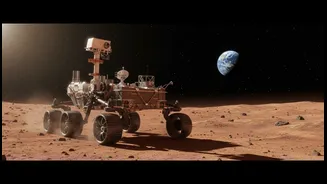
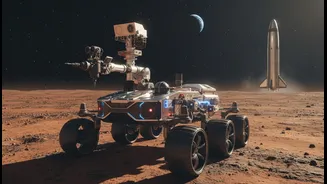
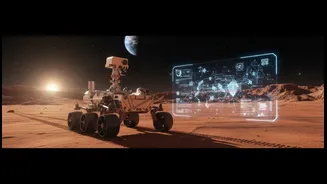
Traditionally, getting to Mars has been the exclusive domain of national space agencies. Missions like the SUV-sized Curiosity and Perseverance rovers are multibillion-dollar, decade-long endeavors. NASA designs, builds, and operates almost everything
from the ground up: the rocket, the spacecraft, the scientific instruments, and the complex landing systems. This approach has yielded incredible scientific discoveries and iconic moments, but it's also incredibly slow and costly. The enormous investment required for these flagship missions means they happen infrequently, often with many years passing between major launches. This slow cadence limits the ability to respond to new discoveries and creates long gaps in our data collection about the Red Planet.
A New Blueprint: The Commercial Services Model
NASA is now pioneering a new approach, one that has already proven successful for delivering cargo and science to the Moon. The agency is shifting from being the sole developer of every mission to becoming a customer for transportation services. Under this public-private partnership model, NASA focuses on what it does best: building sophisticated scientific instruments. It then effectively hires a private company to handle the rest—providing the rocket, building the spacecraft, and managing the journey to Mars. This divides the labor and financial burden. NASA can pour its resources into world-class science payloads, while commercial partners can innovate on launch and spacecraft technology, driving down costs through competition and reusable systems.
Aeolus: The First Test Case
The first major test of this model is the Aeolus mission, scheduled to launch in 2028. In this groundbreaking partnership, NASA is providing a suite of four advanced instruments designed to study the Martian atmosphere. Private aerospace firm Relativity Space will be responsible for building the spacecraft to house these instruments, launching it on their rocket, and operating the mission all the way to Mars. For NASA, it's a way to get its high-priority atmospheric science instruments to Mars without the expense of a full, self-managed flagship mission. For Relativity Space, it’s a high-profile opportunity to prove its deep-space capabilities. As NASA Administrator Jared Isaacman stated, these partnerships act as a "force multiplier for science," allowing the agency to "deliver more science, more often."
The Promise of Speed and Focus
The main goal of this strategy is to increase the "mission cadence"—the frequency of launches to Mars. Earth and Mars align for favorable launch windows only once every 26 months, and under the old model, NASA could not afford to take advantage of every opportunity. By using lower-cost commercial services, the agency hopes to send smaller, more focused missions to Mars during more of these windows. Instead of one giant, do-everything rover every decade, imagine a steady stream of smaller orbiters, landers, and other specialized probes. This would allow scientists to gather continuous data, quickly follow up on new findings from missions like Perseverance, and build a more comprehensive, real-time understanding of the planet.
Building a Martian Ecosystem
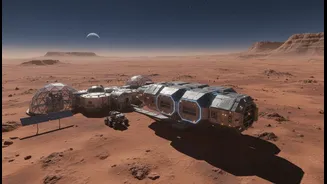
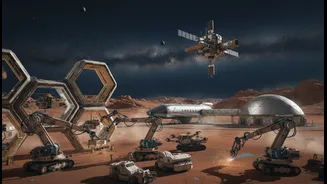
This model isn't just about one-off missions; it's about building a sustainable, long-term presence at Mars. Just as commercial cargo and crew missions have created a vibrant economy in low-Earth orbit, NASA hopes to foster a similar ecosystem for Mars. By providing a steady stream of contracts for transportation, the agency can encourage more companies to develop interplanetary technologies. This could lead to a future with multiple providers competing to deliver payloads, deploy satellite constellations for communication and GPS, and scout landing sites for future human explorers. This robust commercial infrastructure is seen as essential for reducing the risks and costs of eventually sending astronauts to the Red Planet.