






The Quantum Compass in a Bird's Eye
Many animals, from sea turtles to bats, can sense the Earth's magnetic field, an ability called magnetoreception. For birds, this sense acts as an internal compass, but it's far more complex than a simple needle pointing north. The leading theory suggests
this compass is located in the bird's retina and operates on a quantum level. A light-sensitive protein called cryptochrome, when struck by blue light, forms a 'radical pair'—two molecules with electrons whose quantum states are linked. The Earth's magnetic field influences how long these radical pairs last, creating a visual pattern of light and shade that the bird can literally see, superimposed over its normal vision. This pattern changes as the bird turns, providing a constant directional reference.
Why a Daily 'Reboot' Is Necessary
Unlike a physical compass, this quantum compass is not fixed. It's an 'inclination compass', meaning it detects the angle of the Earth's magnetic field lines relative to the surface, not the polarity. This tells the bird the direction of the poles versus the equator, but it can be prone to error. To maintain its accuracy, especially across vast distances where the magnetic field's properties change, the compass needs a reliable, external reference point to calibrate against. Research on species like the Catharus thrush has shown that birds perform this calibration daily. In one key study, when birds were exposed to an artificially shifted magnetic field during twilight, they flew in the wrong direction that night but corrected their course on subsequent nights, suggesting a daily reset.
The Magic of Twilight Polarised Light
The crucial external reference for this daily reset comes from the unique properties of light at sunrise and sunset. During these twilight periods, sunlight scatters in the atmosphere, creating a distinct band of polarised light across the sky. Polarised light is light that oscillates in a single plane. This band of intense polarisation is always located 90 degrees from the sun's position. For a bird, this provides a stable, geographically true East-West axis. By observing the pattern of polarised light on the horizon at sunrise and sunset, a bird can determine the true geographic north-south axis. This provides the absolute directional anchor it needs to fine-tune its internal magnetic sense for the journey ahead.
An Interconnected Sensory World
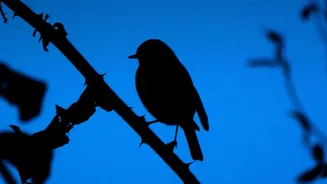
The discovery of this calibration system highlights the sophisticated way birds integrate multiple sources of information to navigate. Their magnetic compass, star patterns, and the sun are all tools in their navigational kit. Polarised light at twilight appears to be the master reference that allows the bird to ensure all its other compasses are aligned correctly. Studies have shown that when the direction of polarised light is aligned parallel to the magnetic field, the bird's compass works perfectly. However, if the polarised light is perpendicular, the birds can become completely disoriented. This shows a direct, functional link between what the bird sees in the sky and the quantum compass operating within its eye.
What This Means for Our Understanding
This research solves a long-standing puzzle in animal navigation. It explains how birds can correct for natural variations in the Earth's magnetic field and how they can navigate across the magnetic equator, where the field's inclination flips. The daily recalibration ensures their internal guide is always trustworthy. The findings from species like European robins, Savannah sparrows, and various thrushes reveal a sensory world far more complex than our own. It’s a stunning example of evolution harnessing the subtle rules of quantum physics and the predictable patterns of the sky to achieve one of the most remarkable feats in the animal kingdom.