



The Evening Show: The Pleiades Star Cluster
Your celestial hunt begins in the evening with the Pleiades, a breathtaking open star cluster also known as the Seven Sisters. In the Northern Hemisphere, the Pleiades become visible in October, rising in the east a couple of hours after sunset. Located
in the constellation Taurus, this group of young, hot blue stars is one of the most recognizable patterns in the night sky. To the naked eye, it often appears as a small, shimmering patch of light, like a tiny, misty dipper. In a clear, dark sky, most people can distinguish six or seven individual stars packed closely together, though over 1,000 stars make up the cluster. Its distinct and delicate appearance makes it a rewarding target for any aspiring stargazer.
How to Find the Seven Sisters
Finding the Pleiades is a simple and satisfying exercise in star-hopping. First, locate the famous constellation of Orion the Hunter, which should be easily identifiable by its distinct 'belt' of three bright stars in a short, straight line. Imagine extending that line from Orion's belt upwards and to the right. This imaginary line will first point you to a very bright, reddish-orange star named Aldebaran, which marks the eye of Taurus the Bull. Don't stop there. Continue tracing that same line a little further past Aldebaran until you spot the compact, hazy cluster of the Pleiades. Once you spot that faint, fuzzy patch, you've found them. The entire cluster is about two-thirds the width of Orion's Belt, making it a tight-knit family of stars.
The Morning Giant: Jupiter Awaits
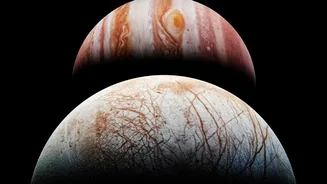
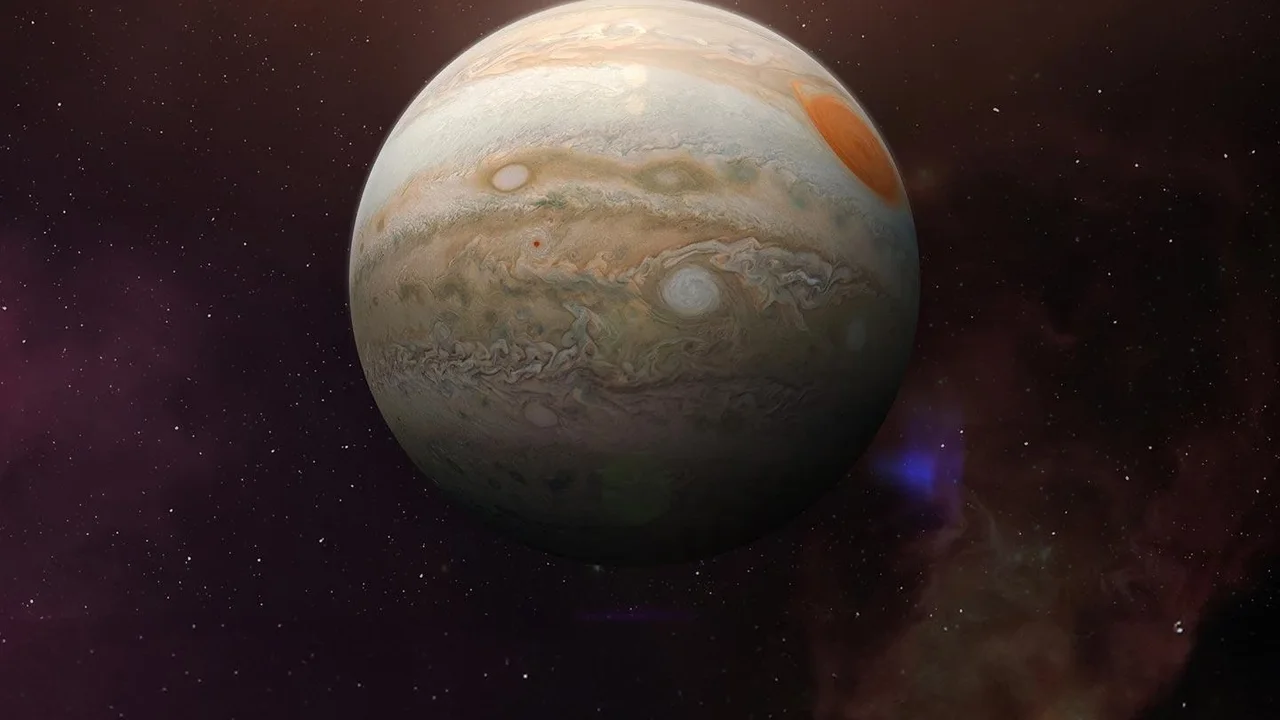
While the Pleiades grace the evening sky, Jupiter commands the stage in the early morning hours. As the largest planet in our solar system, it shines with an incredible brilliance. In October 2026, Jupiter rises in the east-northeast around 2 or 3 a.m. local time. By the time dawn begins to break, it will be a commanding presence high in the eastern sky. What makes Jupiter so easy to spot is its appearance. Unlike stars, which twinkle due to atmospheric disturbance, Jupiter shines with a steady, serene, and powerful light. Look for a very bright, cream-colored 'star' that vastly outshines everything around it in the pre-dawn sky. Its unwavering glow is a clear giveaway that you are looking at a planet.
A Special Signpost on October 6
This month offers a particularly special treat for Jupiter-spotters. In the very early morning hours of October 6, 2026, a slim crescent Moon will appear extremely close to Jupiter. For observers across much of North America, the Moon will actually pass directly in front of the giant planet in an event called an occultation. Even if you're not in the direct path of the occultation, the pairing will be unmissable. Simply find the Moon before sunrise on that morning, and the dazzling point of light right next to it will be Jupiter. This celestial alignment provides an easy and spectacular opportunity to identify the planet without any doubt.
Essential Tips for Naked-Eye Viewing
You don't need any equipment, but the right conditions are key to a great stargazing experience. The single most important factor is finding a dark location, as far away from city lights as possible. Light pollution washes out fainter objects like the Pleiades. Once you're in a dark spot, give your eyes at least 20 to 30 minutes to fully adapt to the darkness. During this time, avoid looking at any bright white light, especially your phone screen, as it will ruin your night vision. If you need a light, use a torch covered with red cellophane, as red light is less disruptive to your eyes. Finally, be patient. The longer you look, the more stars will emerge from the darkness.