



The tech industry's insatiable demand for computing power is pushing its ambitions to a new frontier: space. But as proposals for massive orbital AI data centers emerge, a conflict is brewing between technological progress and our ancient connection to the
cosmos.
What is Orbital AI Computing?
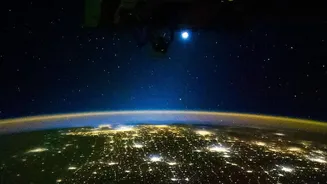
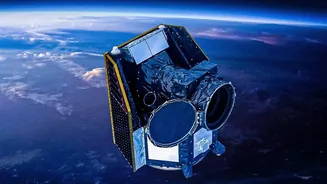
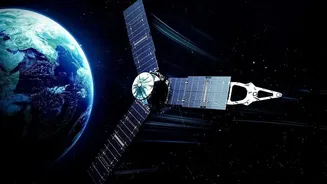
Imagine entire data centers, not in the Nevada desert, but circling the Earth. This is the core idea behind orbital AI computing. Companies are developing networks of satellites equipped with powerful processors, like GPUs and TPUs, specifically designed to run complex artificial intelligence workloads in space. These orbital platforms would harness the sun's constant energy and use the vacuum of space for cooling, aiming to solve the growing energy and land-use crises faced by terrestrial data centers. Instead of beaming raw data down to Earth for processing, these satellites could perform the analysis in orbit, sending back only the finished results. Startups like Starcloud, Aethero, and Sophia Space, along with tech giants, are all exploring this new frontier.
The Race to the Orbital Cloud
The business case for moving AI to space is compelling for its proponents. Terrestrial data centers are incredibly power-hungry; a single AI facility can consume as much electricity as a small city. Space offers what Earth cannot: near-continuous, high-intensity solar power without concerns for weather or nighttime, and a near-perfect vacuum that provides passive cooling, eliminating the need for vast water resources. With the cost of launching payloads into orbit decreasing dramatically thanks to reusable rockets, what was once science fiction is now seen as a viable business strategy. Proposals filed with regulators hint at the sheer scale of these ambitions, with some companies envisioning constellations of tens or even hundreds of thousands of satellites. One filing from SpaceX discusses an eventual constellation of up to one million orbital data centers.
A Sky Full of Satellites
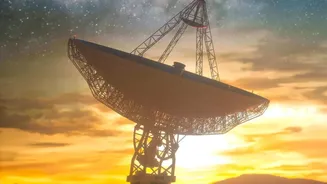
This proposed explosion in orbital hardware has astronomers deeply concerned. For years, they have dealt with the growing problem of satellite mega-constellations, like Starlink, which provide global internet but also create bright streaks across telescope images. These streaks can corrupt or ruin sensitive scientific observations. The number of active satellites has already grown exponentially since 2019, but the planned orbital data centers represent a new level of threat. Unlike smaller communication satellites, these platforms would need much larger solar arrays to power their intensive computing tasks, making them significantly brighter and more reflective.
The View from the Ground
The impact would not be limited to professional observatories. Simulations conducted by astronomers paint a startling picture of our future night sky. An analysis of a million-satellite constellation found that for large parts of the year, the number of visible satellites could outnumber the visible stars. These satellites would reflect sunlight long after sunset and before sunrise, creating a persistent artificial twilight. The cumulative effect of thousands of faint satellites also contributes to an overall brightening of the night sky, a form of diffuse light pollution that can wash out faint celestial objects like the Milky Way for everyone on Earth. For astronomers, this could make it impossible to study faint, distant objects or track potentially hazardous asteroids.
The Search for a Solution
Astronomical organizations like the International Astronomical Union (IAU) are in active dialogue with satellite operators to find solutions. Past efforts have led to companies applying anti-reflective coatings and adjusting satellite orientations to reduce brightness. However, experts warn that these mitigation tactics may not be enough to counter the sheer number and size of the proposed data center constellations. The scientific community is pushing for stronger regulations, both nationally and internationally, arguing that orbital space should be considered part of the human environment and subject to impact assessments. They recommend hard limits on satellite brightness and total satellite numbers to prevent irreversible damage to both scientific research and humanity's shared cultural heritage of a dark and quiet sky.