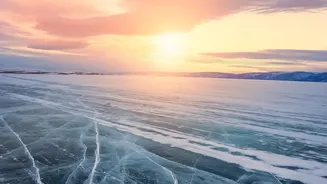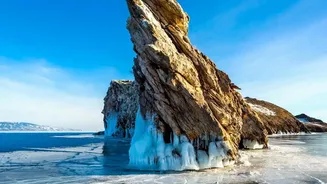






In the depths of a Siberian winter, a breathtaking natural wonder emerges. Lake Baikal, the world's oldest and deepest lake, shrugs off its liquid form and transforms into a kingdom of crystalline, turquoise ice under brutally cold conditions.
The Pearl of Siberia
Nestled
in southeastern Siberia, Lake Baikal is a body of water defined by superlatives. At 25 to 30 million years old, it is the most ancient lake on Earth. It is also the world's deepest, plunging to a staggering 1,642 metres, and it holds about 20% of the planet's unfrozen fresh water—more than all the North American Great Lakes combined. This immense basin is a UNESCO World Heritage site, celebrated for its unique ecosystem and often called the 'Galapagos of Russia'. It hosts thousands of plant and animal species, a large majority of which are endemic, meaning they are found nowhere else on the planet. Perhaps the most famous resident is the Baikal seal, or nerpa, the world's only exclusively freshwater seal species.
The Science of a Natural Jewel
The lake's most famous winter spectacle is its astonishingly clear, blue-green ice. This isn't your average frozen pond. The phenomenon is a result of several factors working in concert. Baikal's water is exceptionally pure and low in minerals. As winter sets in, with air temperatures plummeting to -20°C and often colder, the lake freezes slowly from the surface down. This gradual process, combined with the water's purity and pressure, forces out air bubbles and impurities, creating a solid, transparent sheet. The ice acts like a natural filter for sunlight. It absorbs the longer wavelengths of light (reds and oranges) and allows the shorter, blue wavelengths to penetrate and scatter, resulting in the vibrant turquoise and sapphire hues that make the ice appear to glow from within. The clarity is so profound that in some areas, you can see up to 40 metres down to the lakebed through a metre-thick layer of ice.
A Landscape of Ice Sculptures
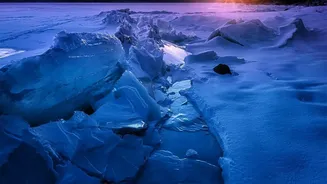
The dramatic beauty of Baikal's winter isn't limited to its colour. The immense pressure within the frozen lake, combined with strong winds and temperature fluctuations, shatters the ice sheet, thrusting massive shards upwards. These jagged fields of broken ice are called hummocks, or 'torosy', and can rise to heights of 12 metres. Another strange and beautiful sight is known as 'Baikal Zen'. This occurs when winds sweep stones onto the ice surface. The sun warms the dark stone, which melts the ice directly beneath it. The wind then carves away the surrounding ice, leaving the stone perched delicately on a thin ice pedestal. Scientists have also been fascinated by giant ice rings, some several kilometres in diameter and visible from space. Once a mystery, these are now believed to be caused by warm, circular water currents, or eddies, that swirl beneath the ice sheet, thinning it from below in a perfect ring shape.
Surviving the Siberian Freeze
Experiencing this winter wonderland requires respecting the harsh conditions that create it. From January to May, the lake is typically frozen solid, with ice reaching an average thickness of one to one-and-a-half metres, strong enough to support vehicles. However, winter air temperatures regularly hover between -19°C and -25°C, and can drop to -40°C during cold snaps. Powerful winds, such as the infamous Sarma wind, can sweep across the lake, adding a significant wind chill factor and shaping the ice into its otherworldly forms. Despite the cold, the region is known for its high number of sunny days, which makes the brilliant ice even more spectacular. The peak time for visitors to witness the blue ice is often February, when the ice is at its thickest and most transparent before the March sun begins to bring slightly warmer temperatures.
A Fragile Winter Paradise
While its winter armour appears formidable, Lake Baikal's ecosystem is delicate. Scientists have raised alarms about a number of threats to its unparalleled purity. Climate change is a primary concern, with the region's average temperatures rising faster than the global average. This leads to shorter periods of ice cover and warmer water, which can disrupt the life cycles of its many cold-adapted, endemic species. Pollution from unchecked tourism, inadequate sewage treatment in coastal towns, and industrial legacy waste also poses a significant risk. These pollutants contribute to harmful algal blooms in shallower waters, choking out native species and signalling a concerning shift in the lake's delicate ecological balance.