




An Earth-Like World, But Colder and Stranger
At first glance, Titan sounds surprisingly familiar. It’s the only moon in our solar system with a substantial atmosphere, and it features a weather cycle similar to Earth's. But instead of water, it rains liquid methane and ethane, which flow across
a surface of water ice as hard as rock and into vast lakes and seas. Its atmosphere is about 95% nitrogen, but it's also rich in organic molecules created when sunlight breaks down methane. This unique combination of familiar processes with alien ingredients makes Titan a top-priority target for scientists studying how life might begin.
A Natural Laboratory for Prebiotic Chemistry
The key to Titan's scientific value lies in its potential as a massive, natural laboratory for prebiotic chemistry. Prebiotic chemistry is the study of the chemical steps that occurred on early Earth before life emerged. On our planet, geological processes and life itself have erased most of this ancient evidence. But on frigid Titan, these processes have been preserved. The moon's atmosphere is constantly creating complex organic molecules that rain down onto the surface, forming a layer of compounds that may be similar to Earth's primordial soup. Scientists believe that if these organic materials ever mixed with liquid water, perhaps from an impact crater melt or cryovolcanic flow, they could have formed amino acids—the fundamental building blocks of proteins.
The Search for Life's Ingredients
While the Dragonfly mission is not looking for existing life, it is searching for chemical biosignatures—evidence that the process of life may have started. The mission has three primary goals: to investigate how far prebiotic chemistry has progressed, to characterize the habitability of Titan's environment, and to search for chemical signs of past or present life, whether it's water-based or even something more exotic that uses liquid hydrocarbons like methane as a solvent. Titan contains all the necessary ingredients for life as we know it: carbon-based organic molecules, energy from the sun, and a subsurface ocean of liquid water. Dragonfly will provide our first on-the-ground look at how these ingredients have interacted over billions of years.
Dragonfly: A Drone for a New World
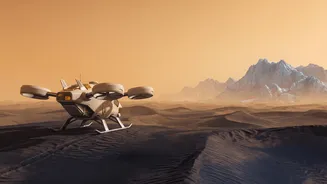
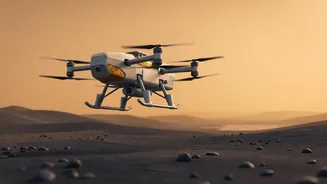
To explore this complex landscape, NASA designed something entirely new: Dragonfly. It's a car-sized, nuclear-powered rotorcraft, essentially a dual-quadcopter designed to fly in Titan's unique environment. Titan's thick atmosphere and low gravity make powered flight much easier than on Earth or Mars, allowing the craft to cover huge distances. Scheduled to launch in July 2028 and arrive at Titan in 2034, Dragonfly will fly from site to site, landing to sample and analyze the surface. This mobility is crucial, enabling it to explore diverse locations like organic-rich dunes and the Selk impact crater, where liquid water may have mixed with surface organics in the past.
The Tools for Discovery
Dragonfly is equipped with a sophisticated suite of instruments to analyze Titan's chemistry. Its mass spectrometer will determine the composition of surface materials, while a drill will acquire samples from below the immediate surface. Cameras will provide high-resolution images of the terrain, and a suite of sensors will measure weather conditions and even potential seismic activity, or "Titanquakes." Over its multi-year mission, Dragonfly plans to fly more than 175 kilometers, nearly doubling the total distance traveled by all Mars rovers combined, giving scientists an unprecedented survey of this mysterious and vital world.