



The Violent Birth of a Giant
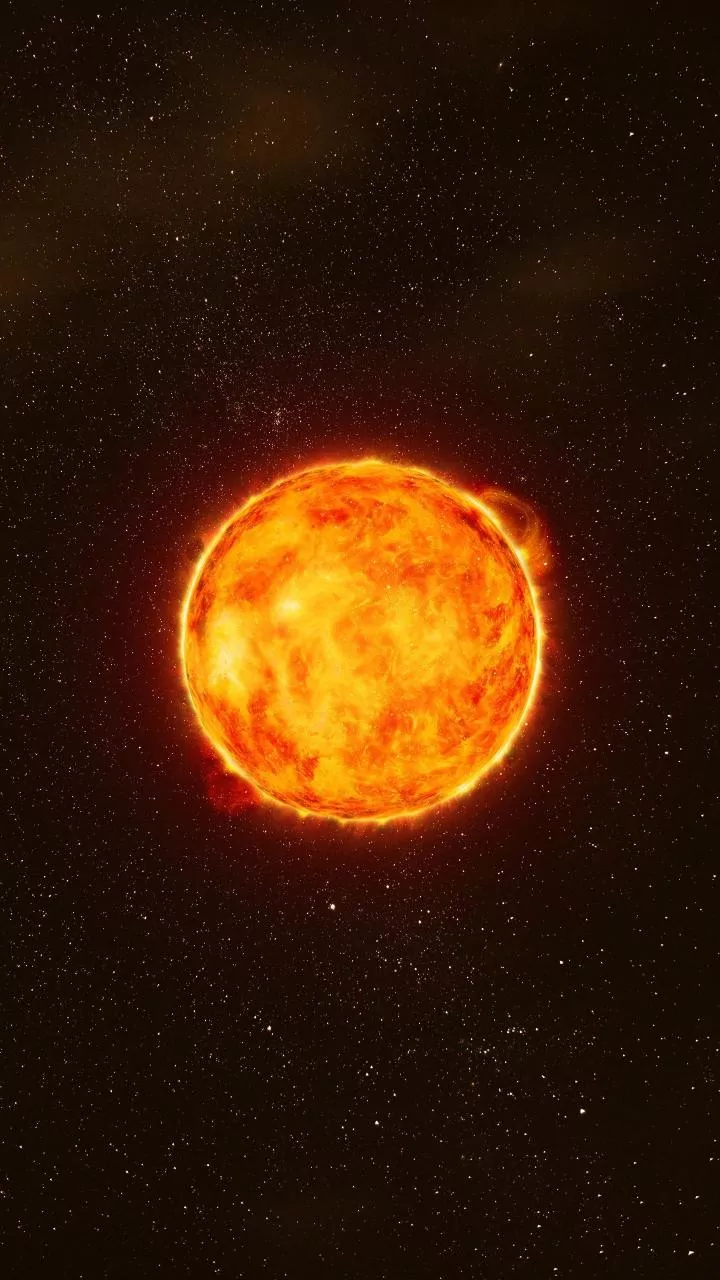
The story of a neutron star begins with the death of a much larger one. When a massive star, one that is at least eight times the mass of our Sun, exhausts its nuclear fuel, it can no longer support its own immense weight. The delicate balance between
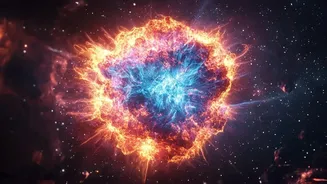
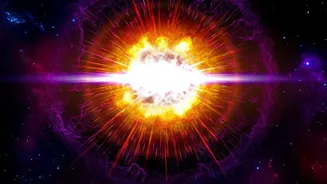
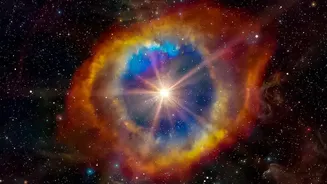
the outward pressure from nuclear fusion and the inward pull of gravity is broken. Gravity wins, triggering a catastrophic collapse of the star's core in mere seconds. This collapse rebounds in a titanic explosion known as a supernova, blasting the star's outer layers into space. What's left behind is the star's incredibly compressed core—the object that will become a neutron star.
Gravity's Unrelenting Squeeze
With the outward pressure gone, the core collapses under its own stupendous gravity. Normal matter is mostly empty space; an atom is like a tiny nucleus with electrons orbiting at a relatively vast distance. But the gravity of a collapsing star is so powerful that this empty space is eliminated. The atoms themselves are crushed. The gravitational force is so extreme that it overcomes the electrical repulsion that keeps electrons and atomic nuclei apart. All the matter in the star's core, equivalent to more than the entire mass of our Sun, is squeezed into a sphere only about 20 kilometres in diameter.
Forging a Star of Neutrons
As the core is crushed, the pressure becomes so intense that electrons are forced to combine with protons inside the atomic nuclei. This process, known as electron capture, transforms them into neutrons. The star effectively becomes a gigantic atomic nucleus, composed almost entirely of neutrons packed tightly together. This is where the 'neutron star' gets its name. The matter is so compressed that there are virtually no gaps left between particles, which is the primary reason for its extraordinary density.
The Last Line of Defense
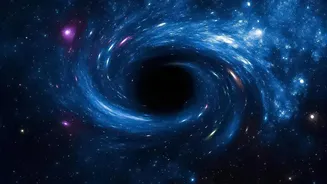
So, if gravity is this powerful, what stops the core from collapsing indefinitely into a black hole? The answer is a quantum mechanical phenomenon called 'neutron degeneracy pressure'. Based on a rule called the Pauli Exclusion Principle, no two neutrons can occupy the exact same quantum state in the same space. As gravity tries to crush the neutrons closer together, they resist, creating a powerful outward pressure that counteracts the gravitational collapse. This degeneracy pressure is the final barricade that supports the neutron star and keeps it stable, as long as its mass does not exceed a certain limit—roughly two to three times that of our Sun. If it does, even this immense pressure will fail, and a black hole is formed.
A Teaspoon Heavier Than a Mountain
To put this density into perspective, consider a mind-boggling analogy. If you could somehow scoop up a single teaspoon of material from a neutron star, it would have a mass of billions of tonnes. The exact weight estimate varies, from 10 million tonnes for matter from the crust to several billion tonnes for matter from the core, but in any case, it would weigh more than Mount Everest. This is because you would have a teaspoon not of atoms with empty space, but of pure, ultra-compressed nuclear material. The star's entire substance is comparable in density to the nucleus of an atom, but on a city-wide scale.