




The Sun’s Violent Temper
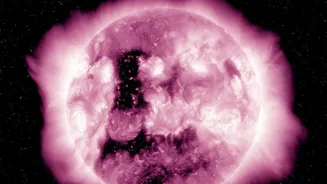
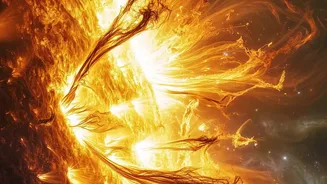
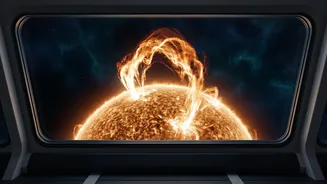
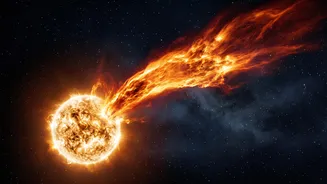
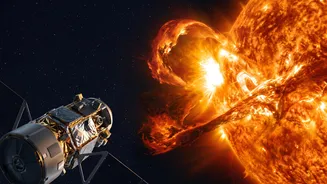
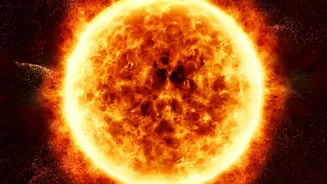
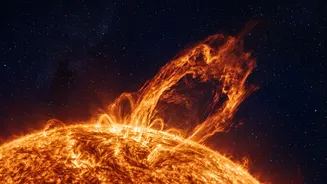
Space weather might sound distant, but its effects can be felt right here on Earth. The primary culprits are solar storms, which include phenomena like solar flares and Coronal Mass Ejections (CMEs). A CME is a massive eruption of magnetised plasma from
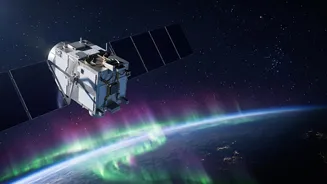
the sun's outer atmosphere that hurtles through space. If one of these is aimed at Earth, it can interact with our planet's magnetic field, triggering a geomagnetic storm. While these storms are responsible for the beautiful auroras, they also carry a significant threat to our modern infrastructure. Think of it as a cosmic electrical disturbance on a planetary scale.
A Threat to Our Digital World
Imagine a world without reliable power, internet, or GPS. A severe geomagnetic storm could make that a reality. These storms can induce powerful electrical currents in the ground, potentially overloading and destroying transformers in our power grids, leading to widespread and long-lasting blackouts. Satellites, which form the backbone of our communication systems, navigation, and financial transactions, are particularly vulnerable. The radiation can damage their sensitive electronics, while the storm can also heat and expand Earth’s atmosphere, creating extra drag that can cause satellites to fall out of orbit. For a nation like India, with its rapidly growing digital economy and reliance on satellite technology, the stakes are incredibly high.
The Challenge of a Cosmic Forecast
For years, predicting the specific impact of a solar storm has been notoriously difficult. Scientists could see a CME leave the sun, but forecasting exactly where and how intensely it would affect Earth’s magnetic field upon arrival was a major challenge. Existing models often provided warnings that were either too broad or came too late to be truly effective. The complex physics involved and the vast amount of data made timely, precise predictions feel just out of reach. This left grid operators and satellite controllers with very little time to prepare for a potential hit.
Enter DAGGER: AI Joins the Watch
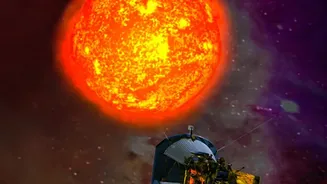
This is where a revolutionary new tool comes in. Developed through a NASA-led partnership, an AI model called DAGGER is changing the game. Standing for Deep Learning Geomagnetic Perturbation, DAGGER uses artificial intelligence to sift through vast amounts of data from spacecraft monitoring the solar wind — the stream of particles flowing from the sun. By training on past storm events, the AI has learned to recognize the subtle patterns in solar wind that precede a geomagnetic disturbance on Earth. A leading researcher on the project, Vishal Upendran, is from the Inter-University Center for Astronomy and Astrophysics in India, highlighting the global and collaborative nature of this crucial effort.
A Game-Changing 30-Minute Warning
DAGGER’s breakthrough capability is its ability to issue highly accurate, location-specific warnings of a geomagnetic storm's impact 30 minutes in advance. While half an hour might not sound like much, in the context of protecting multi-billion dollar infrastructure, it's a lifetime. This advance notice is enough time for utility companies to take protective measures, like temporarily taking sensitive systems offline, and for satellite operators to put their spacecraft into a safe mode or adjust their orbits to minimize damage. Unlike previous models, DAGGER provides fast, global predictions, updated every minute, offering a dynamic and precise view of the incoming threat.
A Safer Future Under the Sun
The development of DAGGER marks a significant leap forward in our planetary defence against space weather. By making the model's code open-source, the researchers have ensured that power companies, telecom operators, and space agencies worldwide can adopt and adapt the technology for their specific needs. This is not just about preventing damage; it's about building resilience into the technological fabric of our society. As we continue to push the boundaries of technology, tools like DAGGER will become indispensable, acting like a planetary siren system that warns us of danger from our nearest star, allowing us to enjoy its warmth without fearing its fury.