




Creating a Fifth State of Matter
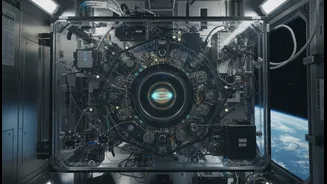
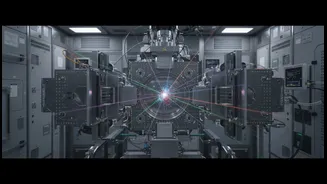
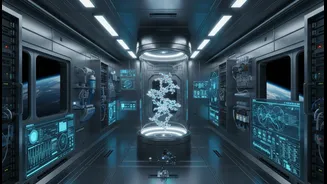
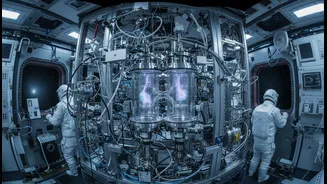
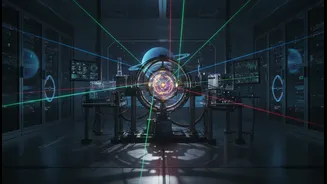
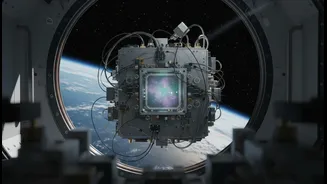
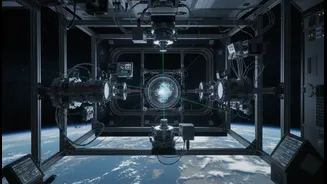
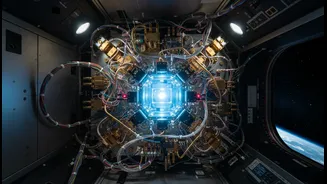
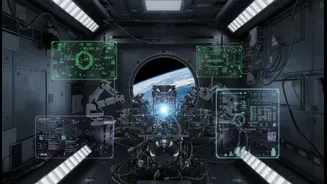
The workhorse of this research is NASA's Cold Atom Lab (CAL), a facility that cools atoms to temperatures just a fraction of a degree above absolute zero, or minus 273.15 degrees Celsius. At these extreme lows, atoms of elements like rubidium and potassium
slow to a near standstill. They stop behaving like individual particles and merge into a single, unified quantum object known as a Bose-Einstein condensate (BEC). First predicted by Satyendra Nath Bose and Albert Einstein in the 1920s and created in a lab in 1995, a BEC is often called the fifth state of matter. In this state, the strange, wave-like nature of atoms, normally confined to the microscopic world, becomes observable on a much larger scale, allowing scientists to study quantum phenomena with unprecedented clarity.
The Microgravity Advantage
While scientists can create BECs on Earth, gravity is a constant interference. The force pulls the delicate atomic clouds downward, limiting observation times to mere fractions of a second. In the microgravity environment of the ISS, however, these limitations disappear. Freed from gravity's pull, the condensates can be observed for much longer periods—for many seconds at a time. This extended duration allows the atom clouds to be cooled to even lower temperatures and lets their quantum waves expand and evolve undisturbed. This unique, stable environment is crucial for making the ultra-precise measurements needed to develop next-generation quantum tools.
From Cold Atoms to Smart Sensors
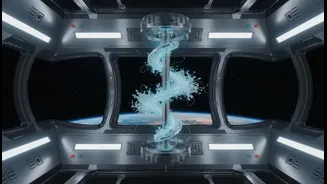
The key to turning cold atoms into sensors is a technique called atom interferometry. It works on a similar principle to how noise-canceling headphones use sound waves. Scientists split a BEC into two identical clouds that travel along different paths before being recombined. Any subtle force, such as a tiny variation in gravity, will affect the two atom waves differently. When they merge back together, the difference creates a specific interference pattern. By reading this pattern, scientists can measure forces with incredible precision. Because atoms move much slower than light, they are more sensitive to these forces over time, making atom interferometers potentially far more powerful than their light-based counterparts.
The Future of Navigation and Exploration
The potential applications for these space-forged sensors are vast. One of the most promising is in navigation. Highly sensitive atom interferometers could lead to navigation systems that don't rely on GPS, a critical capability for submarines, long-duration space missions, or even navigating on the Moon. On Earth, these sensors could revolutionise planetary science and resource management. By flying over a region, a craft equipped with a quantum gravimeter could detect minute changes in gravity, creating high-resolution maps of what lies beneath the surface. This could be used to monitor the melting of ice sheets, track underground water reserves, or even locate mineral deposits for mining.
Testing the Universe's Fundamental Rules
Beyond practical applications, the Cold Atom Lab is a platform for exploring the fundamental laws of physics. Researchers hope to use its precision to test Albert Einstein's equivalence principle, a key part of his theory of general relativity, at the atomic scale. This could help bridge the gap between the world of gravity and the world of quantum mechanics. Scientists also believe these tools could one day help in the search for mysterious cosmic phenomena like dark matter and dark energy. The lab's hardware has been repeatedly upgraded since its 2018 installation, with the latest enhancements in 2026 improving its ability to create and manipulate these exotic matter states, pushing the boundaries of what is possible in quantum science.