

A Slow But Steady Descent
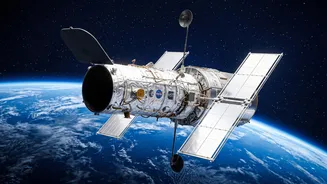
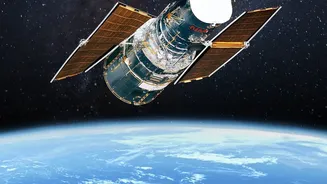
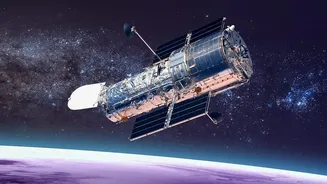
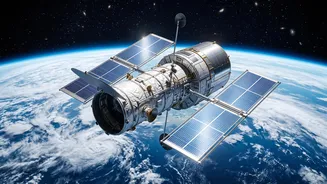
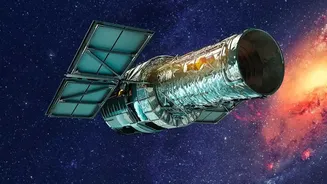
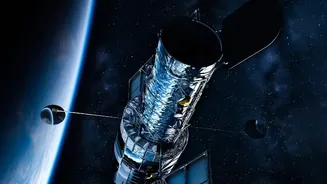
Hubble has no engine of its own. Since its last servicing mission by a space shuttle crew in 2009, its orbit has been gradually decaying due to faint atmospheric drag. This effect, while tiny at its altitude, is relentless. The telescope has dropped from
a peak of over 600 km to well under 500 km. Increased solar activity has accelerated this process recently, pulling the predicted re-entry date forward. NASA's current analysis suggests that if nothing is done, Hubble will re-enter Earth's atmosphere sometime between 2033 and 2034. Because the massive telescope would not completely burn up, NASA has always planned to eventually send a mission to guide it to a safe splashdown in the ocean. Now, the question is whether to send a mission to push it up instead of down.
A Private Lifeline From SpaceX?
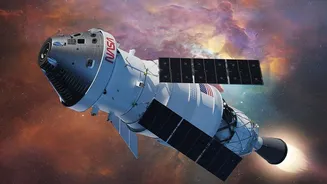
A groundbreaking idea to save Hubble came not from a government agency, but from the private sector. In 2022, billionaire Jared Isaacman, founder of the Polaris Program of private spaceflights, proposed using a SpaceX Dragon spacecraft to visit the telescope. The core of the idea is an orbital 'reboost' — a mission where a Dragon capsule would rendezvous with and dock to Hubble, then use its own thrusters to push the entire observatory into a higher, more stable orbit. A boost to 600 kilometers could add another 25 years to Hubble's operational life. The initial study between NASA and SpaceX was conducted at no cost to the US government, exploring the technical feasibility of such a complex manoeuvre. Though NASA initially passed on the idea, it has recently revived interest.
More Than Just a Nudge
The proposals go beyond a simple orbital boost. A visiting spacecraft could also perform servicing, much like the five space shuttle missions that repaired and upgraded the telescope throughout its life. This could involve a crewed spacewalk, a specialty the Polaris Program has been developing, to repair aging components or even install new instruments. One key issue is Hubble's gyroscopes, which are essential for pointing the telescope. Several have failed, and since 2024, the observatory has been operating in a one-gyro mode to conserve the remaining hardware. A servicing mission could potentially address these hardware limitations, revitalizing the telescope's core functions. However, such a mission is incredibly complex and risky, especially when dealing with the priceless and delicate observatory.
Why Saving Hubble Matters
With the newer, more powerful James Webb Space Telescope (JWST) now operational, some might question the need to save Hubble. But the two are partners, not rivals. JWST is an infrared specialist, designed to peer through cosmic dust and see the most distant, ancient galaxies. Hubble, on the other hand, remains the undisputed champion of visible and ultraviolet light astronomy, capabilities JWST does not have. Many of the most stunning and scientifically valuable discoveries come from combining observations from both telescopes, creating a more complete picture across the entire light spectrum. Losing Hubble would mean losing our primary eye on the universe in these critical wavelengths, ending a unique scientific capability. The demand for its time from astronomers remains incredibly high.
NASA Weighs Its Options
In late October 2026, NASA officially issued a Request for Information (RFI), opening the door for commercial companies to submit their ideas for saving Hubble. The RFI outlines three possibilities: a reboost mission, a servicing mission to enhance capabilities, or a controlled de-orbit to safely dispose of the telescope at its end of life. This move signals a significant shift, formally exploring how the burgeoning private space industry can partner with the agency on highstaked science missions. Any potential rescue mission would need to happen by 2032 to be effective. The responses, due by the end of November 2026, will help NASA understand what is technologically feasible and financially viable, setting the stage for a decision that will determine the fate of one of the most important scientific instruments ever built.