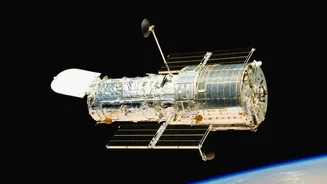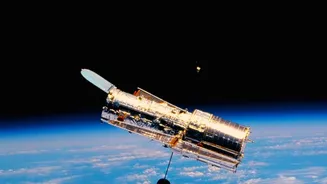








For over three decades, the Hubble Space Telescope has been humanity's tireless eye on the cosmos, delivering breathtaking images and revolutionary science. But a silent force threatens its mission: orbital decay, which is slowly pulling it back to Earth.
What is Orbital Decay?
Like all satellites in low-Earth orbit, Hubble is not entirely free from our planet's grasp. Even hundreds of kilometers up, the atmosphere is not a perfect vacuum. Tiny atmospheric particles create a minuscule but constant drag on the school bus-sized observatory. Since Hubble has no onboard propulsion to counteract this friction, it gradually loses altitude. This process, known as orbital decay, is accelerating due to higher-than-expected solar activity, which causes the upper atmosphere to expand. Currently, Hubble's orbit is shrinking by about 14 kilometers per year. Projections show a significant chance of it re-entering the atmosphere between 2033 and 2035 if no action is taken.
A Legacy of Human Servicing
Hubble's longevity is a testament to its unique design, which allowed for in-orbit repairs and upgrades. Between 1993 and 2009, astronauts aboard five Space Shuttle missions performed heroic spacewalks to fix its initial mirror flaw, replace aging gyroscopes, and install more advanced scientific instruments. These missions repeatedly boosted its orbit and kept it at the cutting edge of astronomy. However, the Space Shuttle program was retired in 2011, leaving NASA without a vehicle capable of performing such complex hands-on servicing missions. For over a decade, Hubble has been on its own, its fate tied to the lifespan of its components and its slowly declining altitude.
A Commercial Lifeline
With no in-house solution available, NASA is turning to the burgeoning private space industry. In late October 2026, the agency issued a formal 'Request for Information' (RFI), inviting commercial companies to propose solutions. This isn't a contract, but rather a way for NASA to gauge the market's capabilities and ideas. The RFI outlines three main possibilities: a mission to boost Hubble into a higher, more stable orbit; a more ambitious mission to service and upgrade its systems; or a final mission to guide it to a safe, controlled de-orbit over an unpopulated area of the ocean. This move follows a 2022 study conducted with SpaceX, spurred by a proposal from the privately funded Polaris Program led by billionaire Jared Isaacman, to investigate using a Dragon spacecraft for a re_boost mission. While that specific plan was not pursued at the time, it opened the door for this broader commercial inquiry.
Robots, Astronauts, or Both?
A future mission would look vastly different from the shuttle era. The primary goal would be to attach a propulsion module to gently push Hubble into a higher orbit, potentially extending its life by 15 to 25 years. A key question is whether this could be done robotically or if it would require a crewed mission. Robotic servicing technology has advanced significantly, with companies developing tugs and other systems for in_space operations. A robotic mission might be seen as lower risk to human life, but a crewed mission offers unparalleled flexibility to handle unexpected problems, a hallmark of the past Hubble servicing missions. The RFI intentionally leaves the options open, asking companies to provide their own concepts, whether they involve astronauts or autonomous systems.
A New Model for Space Operations
This exploration is about more than just one telescope. It reflects a fundamental shift in NASA's strategy. By turning to the private sector for complex operations like servicing a flagship observatory, the agency is embracing a model it has successfully used to ferry cargo and astronauts to the International Space Station. It's a pragmatic approach: if commercial companies can provide these services innovatively and cost effectivly, it frees up NASA's resources to focus on deep space exploration and pioneering new science, like its planned Habitable Worlds Observatory. The potential mission to Hubble could become a landmark case study, proving the viability of commercial partnerships for sustaining critical and expensive assets in orbit.