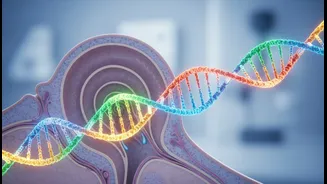









A Breakthrough in Hearing
In recent clinical trials that have captured the attention of the medical world, a new gene therapy has successfully restored hearing in children born with profound deafness. The treatment targets a rare genetic condition caused by mutations in the otoferlin
gene, or OTOF. This gene is responsible for producing a protein crucial for the inner ear's hair cells to communicate sound signals to the brain. Without a functioning OTOF gene, this connection is broken, leading to profound sensorineural hearing loss from birth. Several trials, including the AK-OTOF-101 and CHORD studies, have shown remarkable results. In one instance, an 11-year-old who had been deaf since birth regained hearing just 30 days after a single treatment. Many participants in these studies went from being unable to hear loud noises to perceiving soft speech, with some even achieving normal hearing levels at certain frequencies.
The Inner Ear's Great Challenge
For decades, the inner ear has been considered one of medicine's most difficult frontiers. The cochlea, the spiral-shaped organ of hearing, is a tiny, delicate structure encased in the dense temporal bone of the skull. Its protected location makes it incredibly hard to access without causing damage. Furthermore, its cells, including the vital hair cells that detect sound vibrations, do not regenerate in mammals. This means any damage from genetics, noise, or medication has long been considered permanent. The only effective interventions have been devices like hearing aids or cochlear implants, which amplify sound or bypass the damaged hair cells to directly stimulate the auditory nerve. While transformative for many, these devices do not restore the ear's natural biological function. The dream has always been a regenerative treatment that could repair the ear from within.
A New Delivery System
The success of the OTOF gene therapies hinged on solving this delivery problem. Scientists engineered a harmless adeno-associated virus (AAV) to act as a transport vehicle. This viral vector is emptied of its own genetic material and loaded with a healthy, functional copy of the OTOF gene. The gene therapy, known by names like AK-OTOF or DB-OTO (commercially approved as Otarmeni), is then administered directly into the inner ear. The procedure itself is a feat of minimally invasive surgery. Doctors use special devices to access the cochlea via the round window, a tiny membrane, delivering a single, small dose of the gene therapy without drilling through bone. Once inside, the AAV vector delivers the functional OTOF gene to the inner hair cells, enabling them to produce the necessary protein and restore the transmission of sound signals to the brain. The therapy was found to be safe and well-tolerated, with no serious adverse events reported in the trials.
Beyond a Single Gene
The profound success of the OTOF gene therapy is a proof of concept with implications far beyond this one rare condition. It demonstrates that safe and effective gene delivery to the cochlea is possible. This achievement unlocks the door for researchers to target a host of other genetic hearing and balance disorders. Scientists are already looking at the next major frontier: mutations in the GJB2 gene, which are the most common cause of hereditary hearing loss worldwide. While treating GJB2 mutations may be more complex, the OTOF success provides a validated framework and a surge of momentum for the entire field. It has transformed inner-ear gene therapy from a theoretical possibility into a clinical reality, heralding a new era of restorative medicine for deafness. The development of these therapies signals a fundamental shift from management with devices to a future of biological cures.