






A Legend Dives into Reality
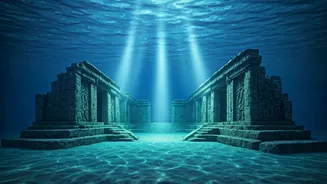
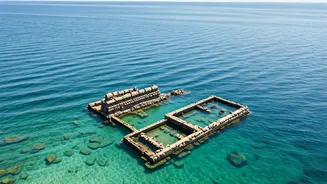
The legend of the ‘Seven Pagodas’ of Mahabalipuram, of which only the Shore Temple remains visible today, is a cornerstone of local folklore. It speaks of a magnificent temple complex swallowed by the sea. For years, fishermen have shared tales of glimpsing
ruins beneath the waves. These stories, once dismissed as myth, have gained scientific credibility over the years. Expeditions in the early 2000s, conducted jointly by India's National Institute of Oceanography (NIO) and international partners, found tantalizing evidence. They discovered submerged walls and scattered stone blocks, suggesting that a significant man-made complex indeed rests below the water.
The New Age of Exploration
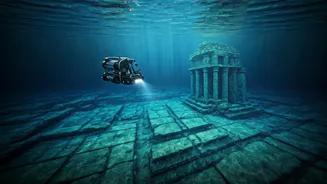
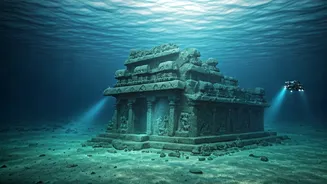
Building on these earlier discoveries, the Archaeological Survey of India's (ASI) Underwater Archaeology Wing (UAW) has recently resumed its exploration. This new phase of the project represents a significant leap forward, primarily due to the deployment of advanced technology. The team is now equipped with a Remotely Operated Vehicle (ROV), a sophisticated underwater drone that can capture high-resolution images and videos of the seabed without disturbing the delicate archaeological site. This allows for safer, more precise, and deeper exploration than was previously possible with diving operations alone, promising to solve riddles of the 7th-8th century Pallava dynasty.
What Lies Beneath?
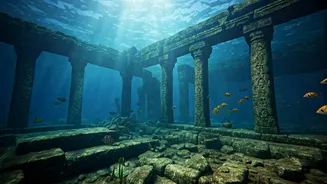
Previous explorations have already confirmed the existence of significant structures. Sonar mapping and diving operations revealed walls, some up to 70 meters long, flights of stairs, and chiseled stone blocks at depths of 5 to 8 meters, located roughly 500 to 800 meters from the coast. Archaeologists believe these ruins date back to the Pallava era. The 2004 tsunami provided a dramatic, fleeting glimpse of this underwater world when the receding waters briefly exposed a long row of granite boulders and other structures, further fueling scientific and public interest. The new project aims to create a comprehensive map of these scattered remains, hoping to understand the layout and purpose of this submerged complex.
Reconstructing a Lost Chapter of History
The significance of this project extends far beyond confirming a local legend. Mahabalipuram was a bustling port city during the Pallava dynasty, with established trade routes connecting it to distant lands. Uncovering the full extent of the submerged structures could offer invaluable insights into the city's original layout, its maritime prowess, and the daily lives of its inhabitants. Discoveries could help reconstruct the history of coastal changes and the potential impact of natural disasters, such as a possible tsunami in the 13th century, that may have led to the city’s partial submergence. Each mapped wall and recovered artifact helps piece together a lost chapter of India's rich architectural and maritime heritage.