


From Flawless to Flawed Art
Remember when the best photo filter was the one no one could detect? We spent years chasing digital perfection, using apps to smooth skin, brighten teeth, and erase any trace of reality that didn't fit our idealised self-image. The goal was to look like
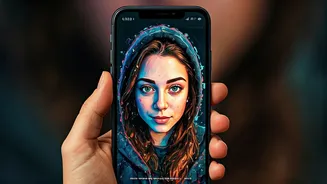
a better version of ourselves. But a fascinating new trend, bubbling up on social media feeds across India and the world, celebrates the exact opposite. Instead of hiding flaws, it embraces them—or rather, it embraces the beautiful, strange, and often surreal flaws generated by artificial intelligence. People are feeding their selfies into AI art generators and falling in love with the imperfect, dreamlike portraits that come back. The slightly melted backgrounds, the painterly brushstrokes that don't quite align, and the occasional six-fingered hand are no longer errors to be corrected; they are the very essence of the art.
The AI Artist in Your Pocket
So how does it work? A host of mobile apps like Lensa AI, Dream by Wombo, and StarryAI have made sophisticated generative AI technology incredibly accessible. The process is simple: you upload a handful of your selfies—the more varied, the better. Then, you choose a style, from 'Anime' or 'Cosmic' to 'Fantasy' or 'Pop Art'. The AI then gets to work. It doesn't just apply a filter over your photo. Instead, it analyses the key features of your face and re-imagines you from the ground up in the chosen aesthetic. It's less like photo editing and more like commissioning a digital artist who has studied your face for a few seconds and then starts painting from memory, adding their own creative flourishes along the way. The results are often startlingly beautiful, capturing a likeness while simultaneously transforming it into something new and fantastical.
The Unexpected Beauty of the Glitch
The real magic of this trend lies in the 'happy accidents'. Because the AI is not a human artist, its interpretation can be wonderfully strange. It might blend your earring into your jawline with a watercolour-like smudge. It might render your eyes in two slightly different, mesmerising styles. Sometimes, the anatomy is just a little 'off' in a way that feels more like a Picasso painting than a technical error. These glitches are the AI’s signature. They are proof that the image wasn't created by a human hand, and that’s precisely what makes it so captivating. A perfectly rendered AI portrait might be impressive, but an imperfect one feels like a discovery. It’s a glimpse into the machine’s digital subconscious, a creative interpretation that a human might never have conceived. This element of surprise and unpredictability is a huge part of the appeal.
A New Form of Digital Self-Expression
This trend is more than just a technological novelty; it speaks to a deeper desire for new forms of self-expression. In a world saturated with carefully curated, hyper-realistic images, these AI portraits offer an escape. They allow us to see ourselves not as we are, but as we could be in a different universe—as a space explorer, a forest elf, or a character in a graphic novel. It’s a form of digital dress-up that goes beyond what any costume or filter could achieve. For many, it's also a surprisingly joyful experience. Seeing your own face, a sight you know so intimately, transformed into dozens of unique artistic variations can be a powerful way to play with identity and decouple your self-worth from a single, 'perfect' image. It’s less about vanity and more about curiosity and imagination.
The Human-AI Collaboration
While there are ongoing debates about AI’s role in the art world, this trend highlights a more collaborative future. The user is not a passive recipient; they are an active participant in the creative process. You choose the source images, you select the styles, and most importantly, you curate the final output. You decide which of the AI’s creations best captures a mood, an aesthetic, or a feeling you want to share. The AI is a powerful, unpredictable tool, but the human is the director. It’s a partnership where our personal photos provide the soul and the algorithm provides the surreal, artistic lens. This collaboration is producing a new visual language, one where personal identity is fluid, artistic, and beautifully, perfectly imperfect.