






An Orbital Junkyard
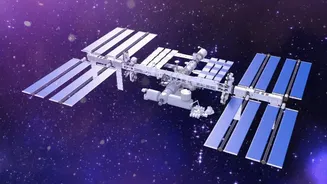
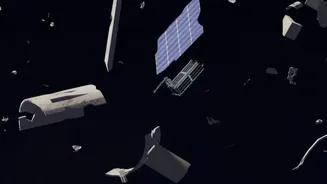
For decades, we have been launching objects into space. While many are active satellites providing crucial services, thousands are now just junk. This includes dead satellites, spent rocket stages, and millions of smaller fragments from past collisions
and explosions. These items are whipping around the planet at speeds up to 28,000 km/hour. The U.S. Space Surveillance Network is currently tracking more than 29,000 large objects, a number that has more than doubled since 2007. The real concern is a scenario proposed by NASA scientist Donald J. Kessler in 1978, known as the Kessler Syndrome. This theory describes a tipping point where the density of debris becomes so high that collisions create a cascading chain reaction, generating more junk and potentially making entire orbits unusable for generations.
The Ancient Hunter's Tool: Harpoons
One of the most direct methods for capturing a large, tumbling piece of debris is a surprisingly old concept: the harpoon. Companies like Airbus have developed and tested space harpoons as a viable capture method. The idea is straightforward: a cleanup satellite, or 'chaser', approaches a target like a defunct satellite. From a safe distance, it fires a tethered harpoon into the target. The harpoon is designed to penetrate the target's outer structure and deploy barbs to ensure a secure grip, much like a whaling harpoon. Once attached, the tether allows the chaser to control the captured object, stabilize its tumble, and then drag it into a lower orbit where it will burn up harmlessly in Earth's atmosphere. This technology was successfully tested in space in 2019 as part of the RemoveDEBRIS mission, which fired a harpoon at 20 meters per second to successfully pierce and capture a target panel.
Casting a Wide Net in Zero Gravity
For capturing debris that might be awkwardly shaped or too fragile for a harpoon, another classic tool is being adapted for space: the net. A chaser satellite would deploy a large net that unfurls to envelop a piece of junk. In one demonstration by the RemoveDEBRIS mission in 2018, a net was successfully used to capture a small target satellite deployed for the test. Once the target is ensnared, the chaser can then tow the entire package to its atmospheric demise. Researchers at institutions like Embry-Riddle Aeronautical University are refining this concept, developing spring-loaded mechanisms that shoot nets toward debris with greater precision. The simplicity and effectiveness of the net make it a leading candidate for active debris removal, with the global market for these systems valued in the hundreds of millions of dollars.
The Sci-Fi Solution: Firing Lasers
Perhaps the most futuristic concept is the use of powerful lasers. This method, known as laser ablation, doesn't require physical contact. A laser, either from a satellite or a ground-based station, is focused on a piece of debris. The intense energy of the laser beam vaporizes a small amount of the object's surface, creating a tiny jet of plasma. This jet acts like a small thruster, gently pushing the debris and altering its orbit. By repeatedly pulsing the laser, operators can nudge the object into a trajectory that will cause it to re-enter and burn up in the atmosphere. Several companies, including the Japanese firm Orbital Lasers, are developing satellite-based laser systems designed to first use ablation to stop debris from tumbling, making it easier for other methods to capture it. This touchless approach reduces the risk of creating even more debris during a capture attempt.
The Business of a Cleaner Orbit
Cleaning up space is no longer just a theoretical exercise; it's an emerging commercial industry. Companies like ClearSpace, commissioned by the European Space Agency (ESA), and Astroscale are developing operational missions to remove debris. ClearSpace's first mission will use a four-armed robotic capture system. Startups like Paladin Space and Portal Space Systems are partnering to offer 'Debris Removal as a Service' by 2027, aiming to make cleanup routine rather than experimental. However, significant challenges remain. The legal and financial questions of who is responsible for old junk and who pays for its removal are complex. Despite these hurdles, the consensus is clear: active debris removal is essential for the long-term sustainability of space exploration and the multi-billion dollar satellite industry that our modern world depends on.