




The Monsoon's Annual Assault on Our Roads
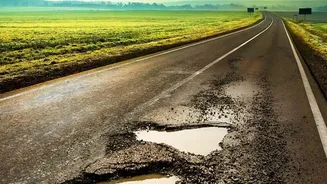
Every year, it’s the same story. Heavy monsoon rains lash the country, and while they are vital for agriculture, they are disastrous for our road infrastructure. Water seeps into tiny, invisible cracks in the asphalt. The constant pressure from traffic
then turns these minor fissures into gaping potholes, creating a dangerous and costly problem that affects millions daily. In 2022 alone, potholes were responsible for thousands of accidents and nearly 2,000 fatalities across India. The cycle of damage and repair is relentless, consuming a significant portion of municipal and national budgets. The Ministry of Road Transport and Highways, for instance, allocated ₹2,600 crore just for road repair in its recent budget, highlighting the scale of the challenge. This endless patchwork offers only a temporary fix, prompting scientists and engineers to search for a more permanent, proactive solution.
The Science of Self-Healing Roads
Imagine a road that can mend itself. This is the promise of self-healing asphalt, a field of material science that is rapidly moving from theory to reality. Instead of just being a passive surface, this new type of asphalt is designed with active components that can repair damage automatically. There are several promising methods being developed globally. Some involve embedding tiny capsules filled with a rejuvenating agent, like sunflower oil, directly into the asphalt mix. When a micro-crack forms, it ruptures the capsules, releasing the oil. This oil softens the surrounding aged binder, allowing it to flow and seal the gap before it can grow into a pothole. This process can extend the life of a road by preventing water from ever getting a foothold.
Bio-Binders: Nature's Repair Crew
The most fascinating approach, and the one hinted at in the headline, involves using biological agents. One method infuses the asphalt or concrete with dormant bacteria, often encased in tiny capsules. When a crack forms and water enters, the bacteria are activated. As a part of their metabolic process, they produce calcite, which is essentially limestone. This calcite fills and seals the crack, effectively healing the damage from within. Researchers at Delft University of Technology have pioneered this method, which they call “bioconcrete”. Another bio-based approach involves developing new binders from renewable sources like waste cooking oil, lignin from pulp mills, or other biomass. These bio-binders can be engineered to have self-healing properties, reducing our reliance on petroleum-based bitumen and making road construction more sustainable.
From the Lab to Indian Highways
This technology isn't just a distant dream. Pilot projects are already underway across the globe, including in the Netherlands and China. Crucially, Indian institutions are also at the forefront of adapting this technology for local conditions. The Central Road Research Institute (CRRI) and IIT-Madras are actively experimenting with polymer-modified and bio-bitumen variants specifically designed for India's tropical climate and heavy traffic loads. In a notable project near Bengaluru, a road was constructed using fibres with a special hydrophilic nano-coating that absorbs ambient moisture to help heal cracks. More recently, two engineering students from Shegaon, Maharashtra, developed a bio-coating with bacteria to repair minor cracks, a project inspired by Dutch innovations and tested locally.
The Road Ahead: Cost and Scalability
While the potential is immense, there are practical challenges to overcome. The initial installation cost of self-healing asphalt can be higher than traditional asphalt. However, proponents argue this is offset by a much longer lifespan and dramatically reduced maintenance costs. Some estimates suggest these technologies can extend a road's service life by 30-40%, from a typical 15-20 years to over 25 years. As the technology matures and production is scaled up, these initial costs are expected to decrease. The National Highways Authority of India (NHAI) is actively exploring these technologies as a long-term strategy to build more resilient infrastructure. The goal aligns perfectly with national missions like Bharatmala, which focus not just on building more roads, but on building better, more durable ones.