




Introducing Eka Robotics
Eka Robotics, a US-based startup founded in 2024 by MIT professor Pulkit Agrawal and former Google DeepMind researcher Tuomas Haarnoja, has emerged from stealth with a bold mission: to build robots that can perform physical work beyond human capabilities.
The company recently announced a massive $150 million Series A funding round, valuing it at $1.45 billion. This significant investment, co-led by major venture capital firms, signals strong confidence in Eka's approach to solving one of robotics' most difficult problems: dexterous manipulation. The founders believe the key is not just to mimic human actions, but to master the underlying physics of interaction.
The Challenge of a Robot's Touch
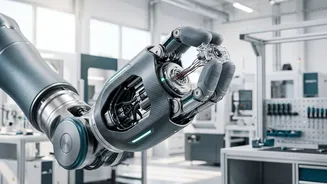
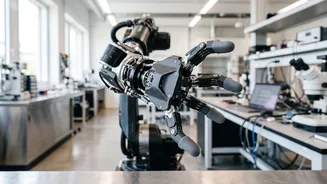
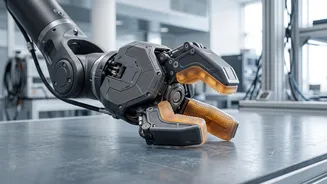
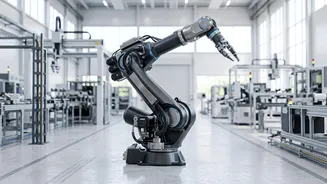
For decades, industrial robots have excelled at repetitive tasks in structured environments, like welding car parts on an assembly line. However, they have struggled with tasks requiring finesse—handling objects of varying shapes, sizes, and fragility. This is the 'last millimeter problem': a robot might see an object perfectly but lack the sense of touch to grasp it correctly without crushing it or letting it slip. Replicating the complex network of nerves, muscles, and feedback loops in a human hand is an immense engineering challenge. Eka Robotics aims to solve this by creating robots that don't just see the world, but can physically feel and react to it in real time.
AI, Force, and Superhuman Speed
Eka's breakthrough is its 'Vision-Force-Action' (VFA) model. Unlike traditional systems that rely mainly on cameras (vision), Eka’s robots integrate data from advanced force sensors in their grippers. This gives the robot a sense of touch, allowing it to dynamically adjust its grip pressure. The 'AI' component comes from reinforcement learning. Instead of being programmed for every possible scenario, the robots learn by performing tasks millions of times in a physics-based simulation. This virtual training allows Eka to generate thousands of hours of experience in minutes, teaching the robot an 'intuition' for physics. The results are impressive: Eka claims its robots can pick and place objects at a rate of 1,500 per hour—more than double the average human's 600—with over 95% accuracy.
From Lab to the Real World
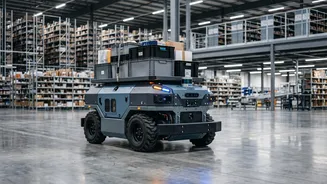
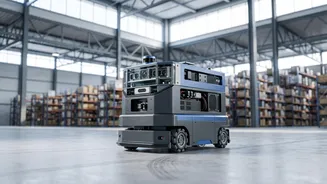
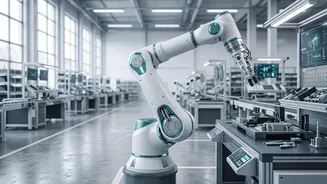
The potential applications for such technology are vast, particularly in sectors that are still heavily reliant on manual labor. In logistics and warehousing, these robots could sort and pack a diverse range of products, from delicate fruits to complex electronics, with superhuman speed. In manufacturing, they could perform intricate assembly tasks, like inserting wires or handling small components. The company is reportedly engaged in pilot projects with industrial partners to test its systems in real-world scenarios. While the technology is promising, the next major hurdle is proving its reliability and durability over millions of cycles in demanding factory environments.
Impact on Indian Industry
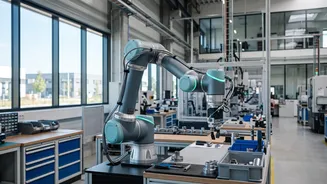
While Eka Robotics is a US-based firm, its technological advancements are highly relevant to India's industrial ambitions. India is one of the fastest-growing robotics markets globally, but still has a very low robot density compared to other manufacturing nations. Programs like 'Make in India' aim to change this by boosting domestic manufacturing. However, a key challenge is moving up the value chain to produce complex, high-quality goods, which requires advanced automation. Technology like Eka's, which offers both high performance and the flexibility to handle varied tasks, could be a game-changer for Indian industries like electronics assembly, automotive components, and food processing, enabling them to compete more effectively on a global scale.