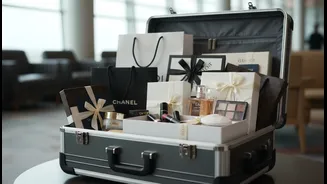







The Core Confusion: Duty-Free vs. Cabin Allowance
The biggest point of confusion for travellers is the difference between two types of allowances: the customs duty-free allowance and the airline's cabin baggage allowance. They are not the same thing. The customs duty-free allowance refers to the value
of goods you can bring into a country without paying import taxes. For instance, when arriving in India, residents can bring in goods worth up to ₹75,000 duty-free. This also includes specific limits on items like alcohol (2 litres) and cigarettes (100 sticks). This is a government rule related to taxes. On the other hand, the cabin baggage allowance is a rule set by your airline. It dictates the number, size, and weight of bags you can carry onto the plane. This is about flight safety, cabin space, and the airline's operational policies.
So, Does It Count? The Airline's Verdict
Here’s the simple, but often frustrating, answer: it depends entirely on the airline. There is no universal rule. Some airlines explicitly state that duty-free bags are permitted in addition to your standard cabin bag allowance. Air India, for example, notes that "a small amount of duty-free goods" may be carried as a personal item.
However, many other airlines, especially budget carriers, are stricter. IndiGo's policy states that any duty-free items are included within the weight limit of your additional personal article, which is capped at 3 kg. Some airline policies explicitly mention that duty-free purchases are included in the overall cabin baggage weight limit. This means if your cabin bag allowance is 7 kg, and your bag already weighs 7 kg, that bottle of perfume or whiskey theoretically puts you over the limit. The enforcement can be inconsistent, but it’s a risk.
The Liquid Problem: STEBs Explained
When your duty-free purchase is a liquid, gel, or aerosol (LAG) over 100ml, like liquor or perfume, another layer of rules applies. To be allowed in your cabin baggage, these items must be sealed at the point of purchase in a special, official bag known as a Security Tamper-Evident Bag (STEB). This transparent bag must remain sealed, with the receipt clearly visible inside, until you reach your final destination.
Opening a STEB before clearing all security checkpoints, especially on connecting flights, will likely lead to your expensive purchase being confiscated. The STEB system is an international standard designed to ensure the items haven't been tampered with after purchase.
The Connecting Flight Trap
Connecting flights are where most travellers get into trouble. Imagine you buy duty-free liquor in Dubai, sealed in a STEB, and fly to Delhi. Your final destination is Bengaluru on a separate domestic flight. After clearing customs in Delhi, you must re-check in for your domestic leg. At this point, Indian domestic security rules take over, which generally prohibit liquids over 100ml in cabin baggage.
Even if your item is in a STEB, you will be required to place it into your checked luggage for the domestic flight. If you are travelling with only a cabin bag, you face a difficult choice: abandon your purchase, or quickly buy a check-in bag and pay the associated fees.
Smart Tips for Duty-Free Shoppers
To avoid stress, fees, and disappointment at the airport, follow these simple guidelines:
1. Check Airline Policy Before You Shop: A quick search on the airline’s website is your best first step. Look for their specific rules on cabin baggage and duty-free items.
2. Leave Space Intentionally: If you know you plan to shop at duty-free, pack your cabin bag a kilogram or two lighter than the limit. This gives you a buffer for any new purchases.
3. Utilise Your Personal Item: Most airlines allow a small personal item like a handbag or laptop bag in addition to your main carry-on. Smaller duty-free items can often be consolidated into this bag, but be mindful of its separate weight limit, if any.
4. Buy on Arrival: The easiest way to avoid baggage allowance issues is to buy from the duty-free shop at your destination airport after you land. You can then put the items in your main luggage without worrying about airline cabin rules.
5. Be Wary on Connecting Flights: If you have a connecting flight, especially a domestic one after an international leg, it is safest to avoid buying liquids over 100ml unless you have checked luggage to put them in.