

Our Planet's Invisible Force Field
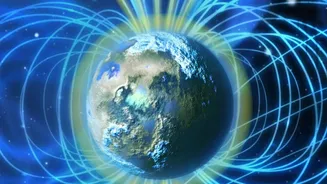
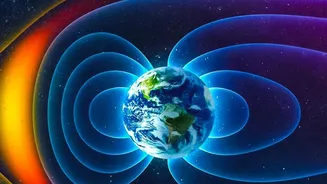
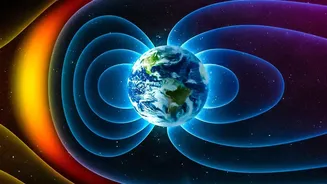
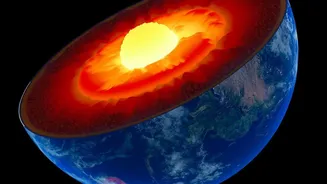
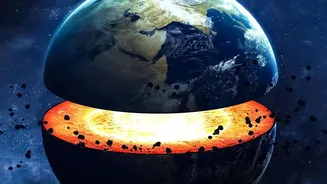
Deep within our planet, the motion of molten iron in the outer core generates powerful electric currents. This process, known as a geodynamo, creates a vast magnetic field that extends from the planet's interior far out into space, forming a protective
bubble called the magnetosphere. Think of it as an enormous, invisible shield. While we can't see or feel it, this field is constantly working, deflecting dangerous particles and radiation that stream from the sun. It's the silent guardian that has allowed Earth's atmosphere to remain stable for billions of years, creating the conditions necessary for life to flourish.
The Constant Solar Assault
The sun, while the source of our warmth and light, is also the source of a relentless threat: the solar wind. This isn't a gentle breeze, but a supercharged stream of particles, mostly protons and electrons, ejected from the sun's corona at incredible speeds. This solar wind carries its own magnetic field and exerts immense pressure. If it were to directly hit our atmosphere, it would act like a sandblaster, stripping away the gases layer by layer through a process called atmospheric erosion or 'sputtering'. This constant barrage would slowly but surely erode our protective ozone layer and the very air we depend on.
A Cautionary Tale From the Red Planet
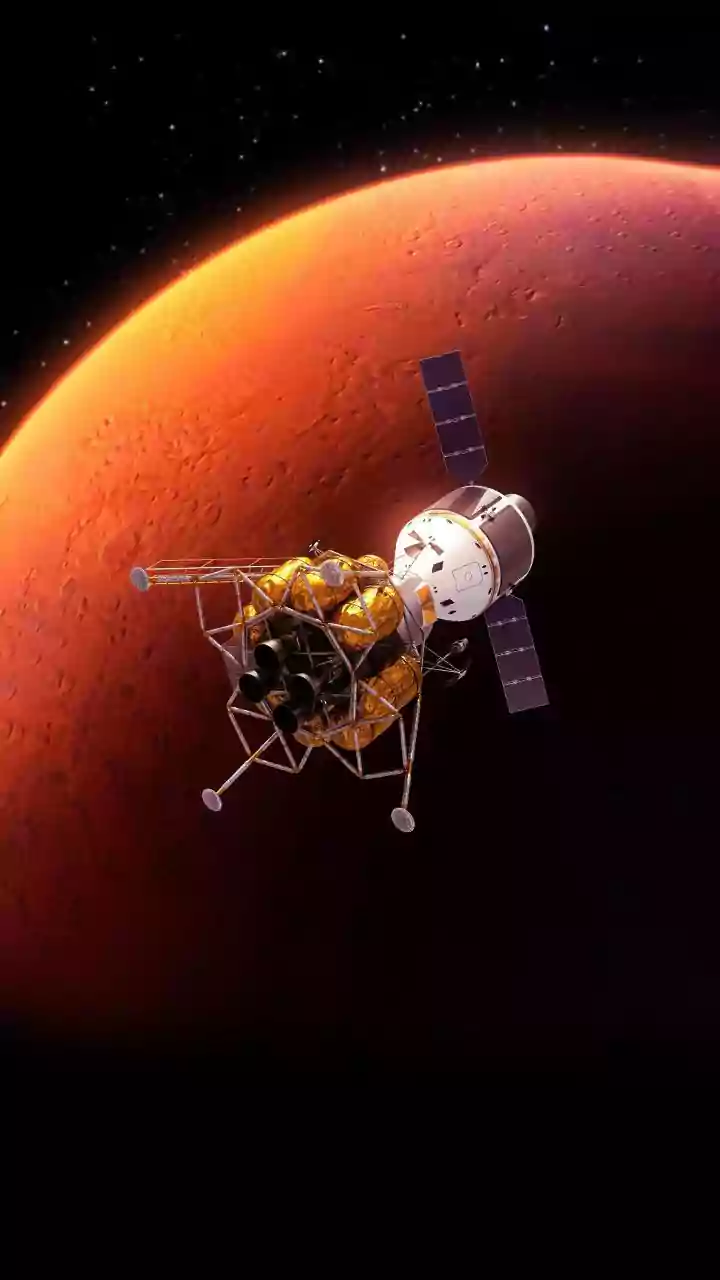
To understand what's at stake, we only need to look at our celestial neighbour, Mars. Evidence strongly suggests that billions of years ago, Mars was a much warmer and wetter world, with a thicker atmosphere and possibly even oceans on its surface. Like Earth, it once had a protective global magnetic field generated by its core. Around four billion years ago, however, the Martian geodynamo shut down. Without its magnetic shield, the relentless solar wind began to strip away the Martian atmosphere over hundreds of millions of years. This process turned a potentially habitable world into the cold, dry, and barren desert we see today, with an atmosphere less than 1% as dense as Earth's.
A World Without Its Shield
If Earth were to lose its magnetic field, the consequences would be catastrophic, unfolding over geological time. The solar wind would begin to erode our atmosphere, thinning it significantly. As the atmospheric pressure dropped, liquid water on the surface would boil away into space. The loss of the ozone layer, which is part of our atmosphere, would allow lethal levels of ultraviolet radiation from the sun to reach the ground. Furthermore, our planet would be bombarded by high-energy cosmic rays, which the magnetosphere also helps to deflect. This increase in radiation would be devastating for life, potentially causing widespread DNA damage.
Is Earth's Shield Failing?
Scientists have observed that the strength of Earth's magnetic field fluctuates and the magnetic poles wander. The field has even weakened by about 30% over the last 3,000 years. At irregular intervals, averaging several hundred thousand years, the poles flip entirely in a process called a geomagnetic reversal. While a weaker field during such a transition could increase some risks, such as damage to satellites and power grids from solar storms, it's crucial to understand that a complete and permanent disappearance of the field, like what happened on Mars, is not considered a likely or imminent scenario. The processes in Earth's core that generate the field are robust and have been active for billions of years, providing a stable shield that continues to make our world a haven for life.