


Seeing the Unseeable
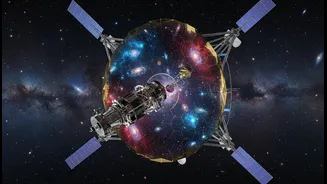
The JWST cannot directly photograph oceans on distant exoplanets. Instead, it uses a powerful technique called transmission spectroscopy. When a planet passes in front of its host star, the telescope analyzes the starlight that filters through the planet's
atmosphere. Different molecules absorb light at specific wavelengths, leaving a unique chemical fingerprint. By decoding these fingerprints, astronomers can identify the gases present, including the all-important signature of water vapor. This method allows scientists to peer into the conditions of worlds light-years away and build a picture of their environment. It’s this ability to detect the chemical makeup of atmospheres that forms the foundation of our new understanding of aquatic worlds.
A Zoo of Water Worlds
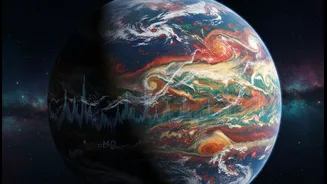
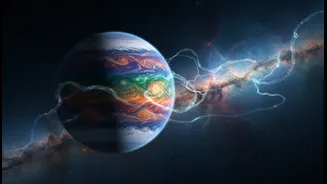
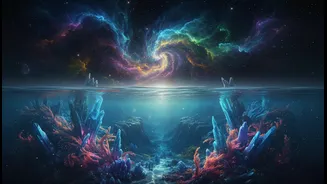
Early theories about water worlds often depicted them as larger versions of Earth, covered in a single, planet-spanning ocean. However, recent JWST data is painting a much more complex and diverse picture. The term 'aquatic environment' is expanding to include a whole spectrum of planetary types. One of the most exciting categories is the 'Hycean' planet, a portmanteau of 'hydrogen' and 'ocean'. These are hypothetical worlds with vast liquid-water oceans under hydrogen-rich atmospheres. The exoplanet K2-18 b, located 124 light-years away, is a prime candidate. Webb's observations have detected methane and carbon dioxide in its atmosphere, with a notable lack of ammonia, which strongly suggests the presence of a large water ocean. This hints that some planets may be entirely aquatic, offering environments vastly different from our own.
Beyond Global Oceans
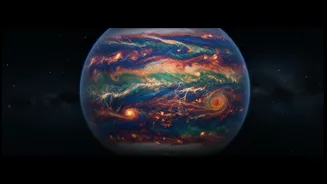
The diversity doesn't stop with Hycean worlds. Observations of other planets, known as sub-Neptunes, are challenging previous assumptions. These planets, which are common in our galaxy but absent from our solar system, were once thought to have atmospheres that were evenly mixed. However, new models informed by Webb's data suggest that on some warmer sub-Neptunes, water might separate from the hydrogen atmosphere and sink, forming distinct, deep layers of water that are hidden from the telescope's view. This means some planets could be hiding vast reservoirs of water beneath the atmospheric layers we can observe. Other worlds might resemble the icy moons of our own solar system, like Europa or Enceladus, with subsurface oceans locked beneath thick shells of ice. The JWST can hunt for clues of these hidden oceans by looking for plumes of water vapor erupting into space, a phenomenon it is well-equipped to detect.
The Chemistry of Habitability
Finding water is just one piece of the puzzle. The true structural diversity of these environments comes from the mix of other chemicals Webb is detecting. On K2-18 b, for instance, astronomers found a possible trace of dimethyl sulfide (DMS), a molecule that on Earth is overwhelmingly produced by marine life like phytoplankton. While this is not definitive proof of life, its potential presence suggests complex chemical processes are occurring. On other, more extreme planets like the lava world 55 Cancri e, Webb has detected a dynamic atmosphere rich in hydrogen and carbon monoxide, likely being replenished by gases venting from a molten surface. This shows how a planet’s geology and its atmosphere are deeply interconnected, creating a unique environmental structure. Understanding this full chemical inventory is crucial for assessing a planet's potential to host life.