




The Universe in a Data Deluge
The biggest challenge in modern space science isn't just reaching for the stars; it's understanding what we see when we get there. NASA's telescopes, rovers, and satellites collect a staggering amount of data. The Earth science archives alone are expected
to hold hundreds of petabytes. For scientists, sorting through this digital mountain is like trying to find a single grain of sand on a vast beach. Manually reviewing every image or data point is impossible, meaning incredible discoveries could remain hidden in plain sight for years. This information overload is precisely where artificial intelligence steps in, transforming a critical bottleneck into a superhighway for discovery.
AI as the Ultimate Research Assistant
Artificial intelligence at NASA isn't about replacing scientists; it's about augmenting them with superpowers. AI models can perform tasks that are tedious or impossible for humans, at incredible speeds. For example, machine learning algorithms sift through data from telescopes like Kepler to find the tell-tale dips in starlight that indicate a passing planet. One system, ExoMiner, has already helped identify over 300 new exoplanets by distinguishing real signals from noise more accurately than previous methods. AI is also being trained to predict cosmic events like solar flares and supernovae, giving scientists a heads-up on where to point their instruments. This allows researchers to focus their expertise on interpreting the fascinating patterns that AI uncovers, rather than spending all their time just looking for them.
Smarter, Faster, Farther
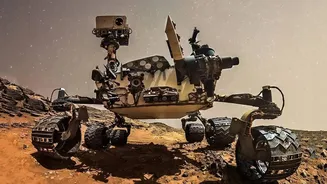
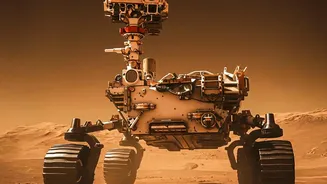
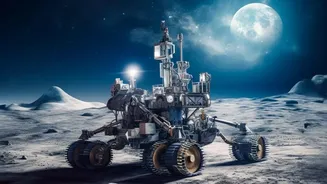
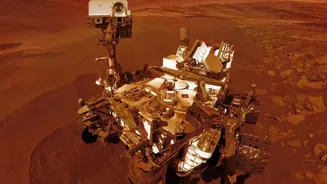
AI's role extends far beyond data analysis on Earth. It is now a crucial component of mission operations in deep space. The Perseverance rover on Mars, for example, relies heavily on AI to navigate the treacherous Martian terrain autonomously. It makes real-time decisions, identifying hazards and charting its own path, allowing it to cover more ground than any of its predecessors. AI systems are also used to make spacecraft more efficient and resilient, helping to plan mission schedules, monitor vehicle health, and even predict potential system failures before they happen. Some systems can even autonomously decide what data is most important to send back, saving precious bandwidth and time.
An Open-Source Revolution in Science
A key part of NASA's strategy is not just to use AI, but to make it open and accessible. Through its Open-Source Science Initiative, the agency is collaborating with partners like IBM to build powerful AI 'foundation models'. One such model, the Prithvi geospatial model, was trained on NASA's vast trove of Earth satellite data and made publicly available. By open-sourcing these powerful tools, NASA aims to empower a global community of researchers, students, and citizen scientists. The goal is to break down barriers, allowing anyone to analyze complex data for applications ranging from tracking deforestation and predicting crop yields to monitoring the effects of climate change.
The Future of Human-AI Exploration
The integration of AI is a fundamental shift in how we approach the unknown. NASA's strategy looks towards a future where AI is a true partner in exploration. The agency is exploring how large language models can act as a 'co-pilot' for scientists, helping them search across decades of mission archives and connect disparate datasets in novel ways. This human-machine collaboration could unlock discoveries in data that has already been collected. From helping astronauts navigate on the Moon's surface using image recognition to managing life support systems in future habitats, AI is being positioned at the core of humanity's next giant leaps into the cosmos.