







Why Choose Step-Ups?
The beauty of the step-up lies in its simplicity and efficiency. As a compound exercise, it works multiple muscle groups at once, including your quadriceps, hamstrings, glutes, and even your core for stability. This makes it a fantastic tool for building
lower-body strength and endurance. Because it's a unilateral exercise, meaning you work one leg at a time, it helps identify and correct muscle imbalances between your left and right sides. This can lead to better overall balance, coordination, and may reduce the risk of injury. It’s also a low-impact movement, which makes it easier on your joints compared to high-impact exercises like running or jumping, all while providing a solid cardiovascular workout if performed at a brisk pace.
Perfecting Your Form
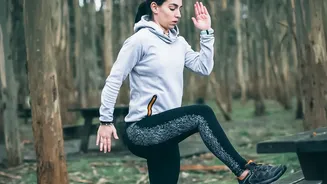
Proper form is crucial to maximise benefits and prevent injury. Start by standing in front of a sturdy, stable platform. A low bench, a staircase step, or a plyometric box are all great options. The ideal height is one where your knee is at roughly a 90-degree angle when you place your foot on top. To begin, plant your entire right foot firmly on the platform. Keeping your chest up and core engaged, drive through your right heel to lift your body up, bringing your left foot to meet the right. The power should come from the leg on the platform, not from pushing off with the foot on the floor. To come down, reverse the motion with control, stepping back with the left foot first, followed by the right. Control on the way down is just as important as the step up.
Finding The Right Platform
You don't need fancy gym equipment to perform step-ups. The most accessible option for many is the bottom step of a staircase in your home. If you don't have stairs, a sturdy, low stool or a robust wooden box can work just as well. Commercial aerobic steps are also a great investment, as their height is often adjustable, allowing you to increase the difficulty as you get stronger. Whatever you choose, ensure it is completely stable and won't slide or tip over during the exercise. Test its stability before you begin your workout. Avoid using cushioned surfaces like a sofa or an upholstered chair, as the unstable surface can throw off your balance and increase the risk of an ankle injury.
Simple Variations to Add Challenge
Once you've mastered the basic step_up, you can introduce variations to keep your muscles challenged. One of the easiest ways to progress is by adding weight. Holding a dumbbell in each hand increases the resistance, helping to build more muscle and strength. Another variation is the lateral step_up, where you stand beside the platform and step up sideways. This movement places greater emphasis on your inner and outer thighs and challenges your stability in a new way. For a more explosive, power_building movement, you can try the sprinter step_up, where you drive the non_stepping knee up high as you reach the top of the platform. Even simply increasing the height of the step will make the exercise more demanding, particularly for your glutes and hamstrings.
Building Your Winter Routine
Incorporating step_ups into your winter fitness plan is straightforward. If you're new to the exercise, start with just your body weight. Aim for 3 sets of 10–12 repetitions on each leg, two to three times a week. Focus on maintaining good form and a controlled pace. As you get stronger, you can increase the number of reps, add weights, or try more advanced variations. For a cardiovascular focus, you can perform step_ups at a faster pace for a set duration, such as 45 seconds on, with 15 seconds of rest, repeated for several rounds. Remember to listen to your body and rest when you need to.