


A New Eye on the Dark Universe
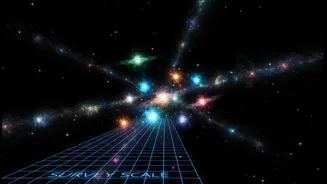
The European Space Agency's Euclid telescope is on a mission to map the cosmic web and uncover the secrets of dark matter and dark energy. Launched in 2023, this powerful observatory is designed to survey a third of the night sky with unparalleled width
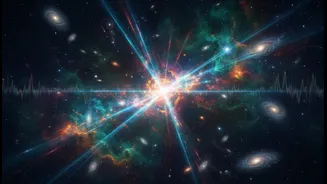
and depth. While its main goal is to understand the 'dark' side of the universe, its powerful gaze is also capturing light from the most distant, and therefore earliest, objects in existence. In just its first couple of years of operation, Euclid has already provided a treasure trove of data, including spotting dozens of new quasars—the intensely bright cores of galaxies powered by supermassive black holes. This has more than doubled the number of such ancient objects known to science, giving us an unprecedented census of the universe's infancy.
The Cosmic Chicken-and-Egg Problem
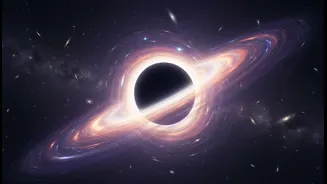
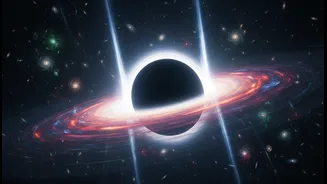
For decades, the prevailing theory has been one of co-evolution: galaxies and the supermassive black holes at their centers grow up together. A galaxy forms, stars are born, and some of those massive stars collapse into small black holes. Over billions of years, these black holes merge and accrete gas, gradually growing into the behemoths we see at the center of galaxies like our own Milky Way. In this model, the mass of the galaxy and its central black hole should be roughly proportional. But what if the black hole came first? This has been a long-standing puzzle in astrophysics, as observations from telescopes like the James Webb Space Telescope and now Euclid keep finding black holes in the early universe that seem far too massive for their young host galaxies.
An Impossible Discovery
The latest Euclid data has thrown this puzzle into sharp relief. The telescope has identified a population of quasars shining from a time when the universe was less than a billion years old. One new record-holder was active just 670 million years after the Big Bang. The black holes powering these quasars are already millions or even billions of times the mass of our sun. According to preliminary estimates, some of these black holes are at least twice as massive relative to their host galaxies as expected based on observations of the modern universe. They simply shouldn't have had enough time to grow that large. It’s like finding a fully-grown adult in a cosmic nursery. This suggests that the standard model of black hole growth, where they start small and grow slowly, might be incomplete.
Rewriting the First Chapter
These findings are forcing scientists to consider more exotic theories for how the first supermassive black holes were born. One possibility is the 'direct collapse' model. Instead of forming from a star, a gigantic cloud of primordial gas in the early universe could have collapsed directly into a massive 'seed' black hole, tens of thousands of times the mass of the sun. This would give them a significant head start on their growth. Another theory involves the mysterious dark matter, suggesting it might have played a role in kick-starting the formation of these early giants. While these ideas were once on the fringes, the mounting evidence from Euclid is making them serious contenders. Scientists are moving from studying a few rare outliers to analyzing a whole population of these puzzling objects for the first time.