




What Is a Planetary Conjunction?
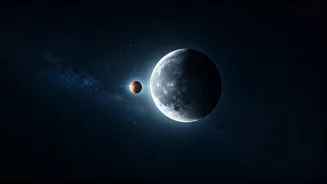
In the vastness of space, planets are separated by millions of kilometres, each tracing its own lonely path around the Sun. But from our vantage point here on Earth, these paths sometimes appear to cross. A planetary conjunction is an optical illusion,
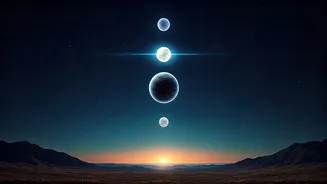
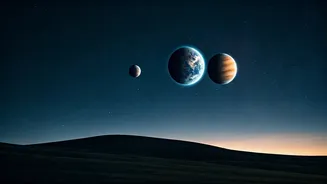
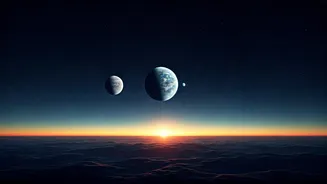
a beautiful trick of perspective. It happens when two or more planets, in their respective orbits, align in our line of sight. They aren't actually close to each other—in fact, they remain unimaginably far apart. But for a brief period, they look like cosmic neighbours, huddled together in a small patch of the night sky. These events are a stunning reminder of the clockwork motion of our solar system and offer a rare chance to see multiple worlds at once without a telescope.
Meet Tonight's Celestial Trio
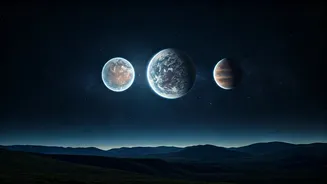
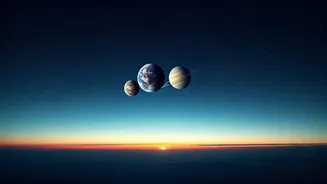
The celestial dance tonight features three distinct and captivating planets: Mars, Jupiter, and Saturn. You’ll be able to see the faint, reddish glow of Mars, our planetary neighbour known for its dusty, cratered surface. Joining it is the king of the planets, Jupiter, which will be the brightest of the three—a brilliant, unblinking beacon of light. Its immense size makes it one of the most dominant objects in the night sky. Completing the trio is the ringed jewel, Saturn. While its famous rings won't be visible to the naked eye, its steady, yellowish-white light adds a touch of elegance to the planetary gathering. Seeing these three worlds, each with its own unique character, in such close proximity is a truly special event.
When and Where to Look From India
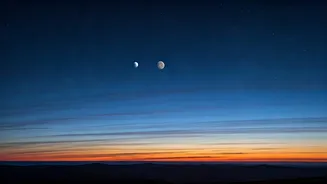
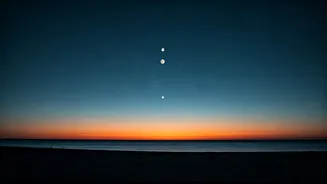
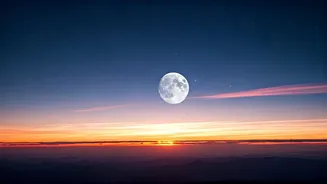
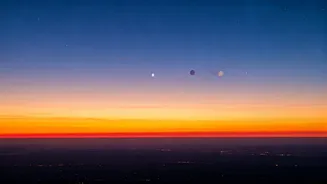
Timing and direction are everything for catching this fleeting spectacle. The best time to look is shortly after sunset, during the twilight hour. For viewers across India, this will be roughly between 7:00 PM and 8:30 PM IST. The planets will appear very low in the western sky. Face the direction where the sun has just set and cast your gaze towards the horizon. The planetary trio will be visible as a small, tight triangle or a slightly slanted line of bright 'stars' that don't twinkle. Because they are low on the horizon, they will set relatively quickly, so the viewing window is short. Don’t wait too late into the night, or you’ll miss them entirely.
Do You Need a Telescope?
Good news for casual stargazers: you don't need any special equipment to enjoy this conjunction. All three planets—Mars, Jupiter, and Saturn—are bright enough to be easily seen with the naked eye, even from moderately light-polluted areas. However, if you have a pair of binoculars, you'll be in for a treat. Binoculars will make the colours of the planets more distinct—Mars’s red, Jupiter’s creamy white, and Saturn’s pale yellow. They will also resolve the planets into sharp discs rather than points of light. If you are lucky enough to have a small telescope, you might even be able to spot Jupiter's four largest moons (the Galilean moons) appearing as tiny pinpricks of light flanking the giant planet.
Tips for the Best Viewing Experience
To maximise your chances of a great view, follow these simple tips. First, find a location with an unobstructed view of the western horizon. A park, an open field, or the terrace of a tall building would be ideal. Second, try to get away from direct streetlights and bright city glare. The darker your surroundings, the more brilliant the planets will appear. Third, give your eyes time to adapt. It takes about 15-20 minutes for your eyes to become fully adjusted to the darkness, allowing you to see fainter objects. Finally, be patient. Scan the western horizon slowly. Once you spot the bright beacon of Jupiter, you will easily find its two companions nearby. You can also use a free stargazing app on your phone to help you pinpoint their exact location.