


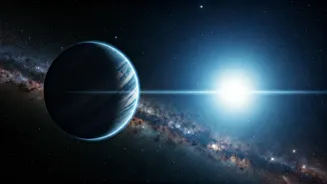



The Planet That Shouldn't Exist
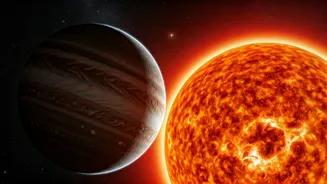
In the cosmic theater, some stories are simply baffling. Take the case of WD 1856 b, an exoplanet located about 80 light-years from Earth. It’s a gas giant, similar in size to our own Jupiter, but its situation is profoundly strange. It orbits a white
dwarf—the tiny, city-sized core left behind after a star like our Sun dies. Making things even stranger, this giant planet whips around its dead star every 34 hours, orbiting at a distance 50 times closer than Earth is to the Sun. According to everything we know about stellar evolution, this planet should not be there. When its star reached the end of its life, it would have swelled into a red giant, a behemoth that should have completely engulfed and vaporized any planet in such a close orbit. Yet, WD 1856 b survived. The puzzle for astronomers was not just that it survived, but how.
Webb’s Powerful Infrared Gaze
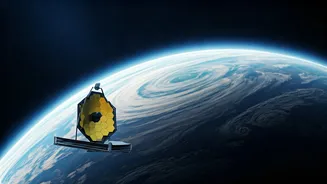
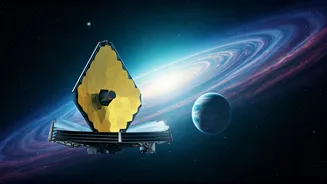
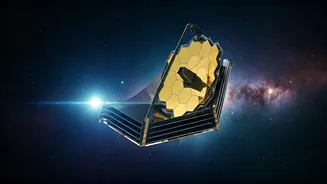
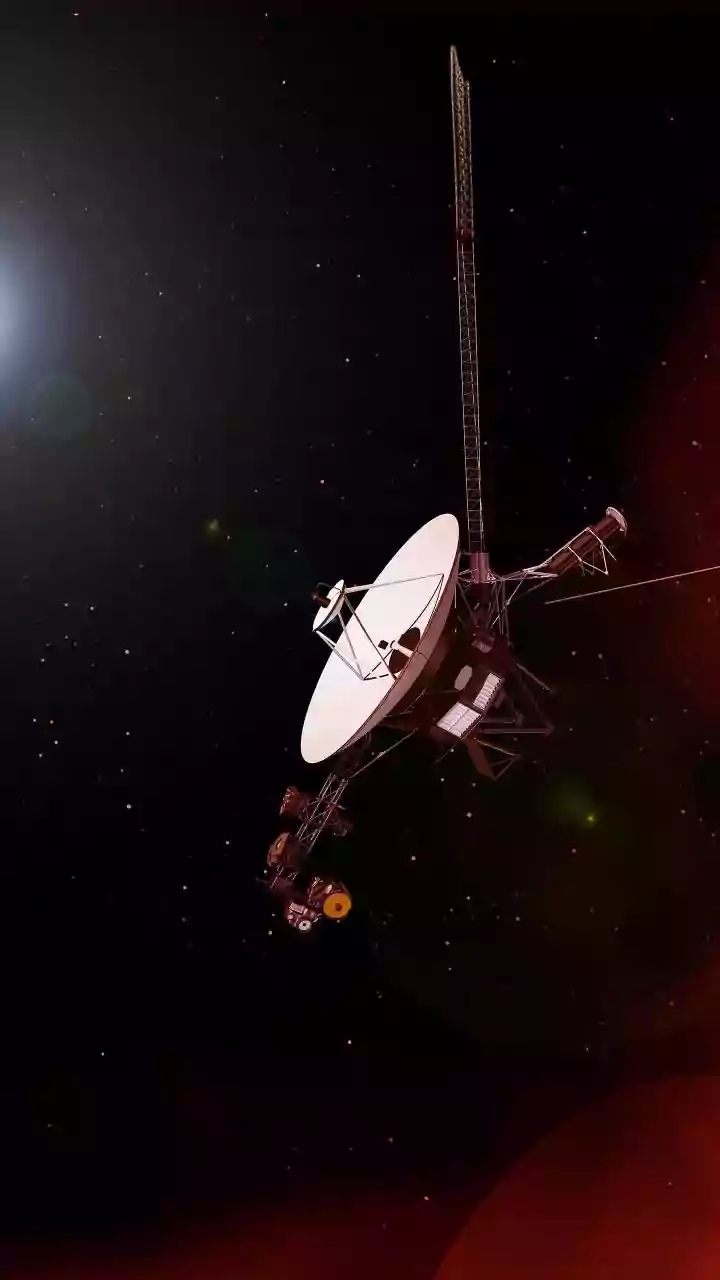
To solve this celestial mystery, an international team of astronomers turned to the most powerful tool in their arsenal: the James Webb Space Telescope. Studying a faint, dead star and its even fainter planetary companion is a monumental challenge. Webb, however, is designed for exactly this kind of work, peering into the universe in infrared light that is invisible to the human eye. The team used a technique called transit spectroscopy. They pointed Webb at the system and waited for the precise moment the planet passed in front of its star. As the starlight filtered through the planet's atmosphere, different molecules absorbed specific wavelengths of light. By analyzing these tiny dips in brightness, scientists can decipher the chemical makeup and temperature of a world light-years away. In this case, observing the transit also allowed them to measure the planet’s own heat radiating into space.
An Unexpectedly Toasty World
The data from Webb delivered a stunning surprise. The planet, WD 1856 b, is significantly warmer than it should be. The white dwarf it orbits is a pale ghost of a star, emitting very little light and heat. Based on this stellar radiation alone, the planet should be frigid. Instead, Webb's measurements clocked its temperature at a relatively balmy 126 degrees Celsius. This was the smoking gun. That extra heat couldn't be coming from the star today, which meant it had to be residual energy from a dramatic event in the planet’s past. The world was glowing with the memory of a past trauma, a warmth that hinted at a journey far more violent than its current, stable orbit would suggest.
The Story of a Great Migration
The unexpected heat allowed scientists to piece together a compelling history. WD 1856 b wasn't always this close to its star. It likely spent the majority of its life in a wide, safe orbit, far away from the star's destructive end-of-life phases. Long after the star had collapsed into a white dwarf, something disturbed the system. Perhaps the gravitational nudges from other stars in its triple-star system kicked WD 1856 b out of its comfortable orbit and sent it spiraling inward. As the planet moved closer, the white dwarf's immense gravity would have squeezed and flexed it, a process known as tidal heating. This constant gravitational kneading generated enormous friction inside the planet, causing it to heat up dramatically. The planet we see today is still cooling down from that violent migration billions of years ago.
A Window into Our Solar System's Fate
The story of WD 1856 b is more than just a fascinating cosmic tale; it’s a potential preview of our own solar system's distant future. In about five billion years, our Sun will also exhaust its fuel, swell into a red giant, and finally collapse into a white dwarf. The inner planets, including Earth, are unlikely to survive this process. But the gas giants of the outer solar system, like Jupiter and Saturn, could endure. The observations of WD 1856 b suggest that these surviving planets may not stay in their current orbits. They could be pulled into new, closer paths around the Sun's remnant, undergoing their own periods of tidal heating. As one scientist noted, studying this system is like using a time machine to peer into the future of our own cosmic neighborhood. It shows that a star's death is not the end for all its worlds; for some, it's the beginning of a strange and vibrant afterlife.