



What Exactly Is a Planetary Alignment?
First, let's clear up a common misconception. A planetary alignment isn't when planets form a perfectly straight line in space, like beads on a string. That kind of perfect syzygy is extraordinarily rare. Instead, what we call an alignment is when several
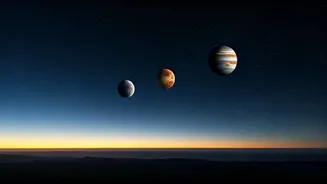
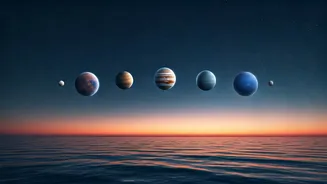
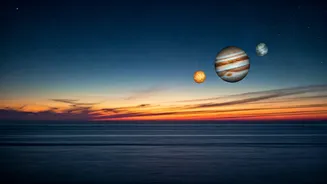
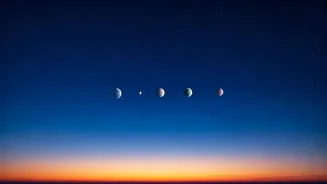
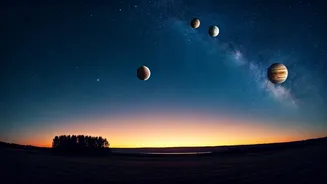
planets appear close together in a small section of the sky from our perspective here on Earth. Imagine the planets orbiting the Sun on a relatively flat plane, like marbles rolling on a giant plate. Every now and then, a few of them happen to be in the same quadrant of that plate at the same time, making them appear clustered in our night sky. This week, we are being treated to a particularly lovely gathering of five planets, a celestial event often called a 'planet parade'.
Meet the Five Planets on Display
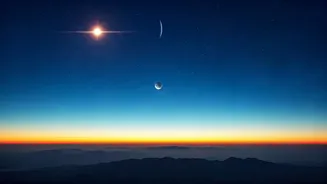
The celestial guest list for this event is quite impressive. You'll be able to spot Jupiter, Mercury, Venus, Uranus, and Mars. Venus will be the easiest to find; it will shine brilliantly as the brightest object in the evening sky, impossible to miss. Jupiter will also be bright, though it will be very low on the horizon and may be challenging to see. Mercury will be situated near Jupiter, also posing a viewing challenge due to its proximity to the setting sun's glare. Mars will be higher up, identifiable by its distinct reddish glow near the Moon. The real prize for dedicated sky-watchers is Uranus, which will be faint and positioned near Venus. While the others are visible to the naked eye, spotting Uranus requires a bit more effort.
Your Step-by-Step Viewing Guide
Seeing this alignment is surprisingly simple if you know when and where to look. Here's your plan: 1. **Timing is Everything:** The best viewing window is a short one—about 30 to 45 minutes right after sunset. As the sun disappears below the horizon, the sky will darken enough for the planets to become visible, but before they too start to set. 2. **Face West:** All the action is happening on the western horizon, the same direction where the sun just set. Find a spot with an unobstructed view, away from tall buildings or trees that might block your line of sight. 3. **Find Venus First:** Your anchor point is Venus. It will be incredibly bright, looking like a powerful, stationary star. Once you’ve located Venus, you can use it to find the others. Mars will be higher in the sky, glowing with its characteristic red tint. Jupiter and Mercury will be much lower, very close to the horizon, so you’ll need a clear view to catch them before they dip out of sight. 4. **Patience Pays Off:** Let your eyes adjust to the dark for a few minutes. City dwellers should try to find a park or a terrace with minimal direct light to reduce light pollution, which can wash out fainter objects.
Do I Need a Telescope?
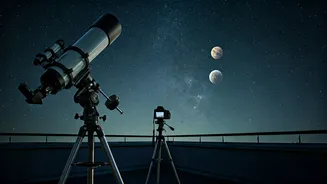
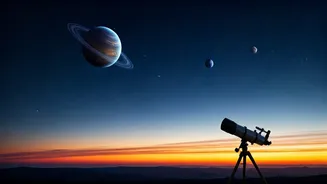
Not necessarily! The beauty of this event is its accessibility. You can easily see Venus, Mars, and likely Jupiter with just your naked eye. They will appear as bright, star-like points of light that don't twinkle as much as actual stars. However, bringing along a pair of binoculars will significantly enhance your experience. With binoculars, you might be able to get a clearer look at Mercury, and you will almost certainly need them to spot the faint, greenish-blue dot that is Uranus, which will be hovering near the much brighter Venus. A telescope would, of course, reveal even more detail—perhaps even Jupiter's largest moons—but it’s not a requirement to enjoy the show.
Why This 'Rare' Show Is Worth Your Time
While alignments of two or three planets are relatively common, seeing five planets clustered together is a much less frequent occurrence. It won't cause any gravitational effects on Earth or signal any cosmic doom—it's simply a beautiful quirk of our solar system's orbital mechanics. These events are a powerful reminder of the vast, dynamic universe we inhabit. They offer a moment to pause, look up from our screens, and connect with the cosmos in a direct and personal way. It’s a chance to share a sense of wonder with family and friends, and to see the planets not as abstract concepts in a textbook, but as real worlds tracing their paths across our own sky.