


Mars's Silent, Suffocating Threat
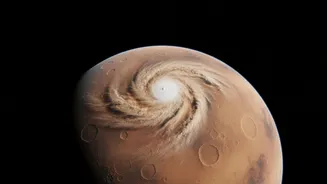
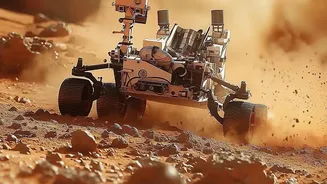
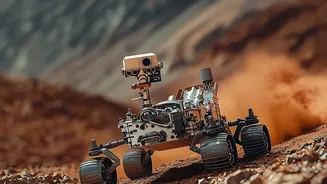
For robotic explorers on Mars, dust is more than just a nuisance; it's a life-threatening hazard. The Martian surface is covered in a fine, talc-like powder that gets kicked up into the atmosphere by winds, creating everything from small dust devils to colossal,
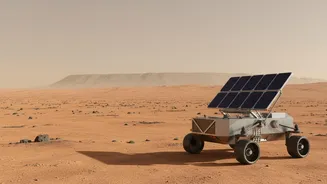
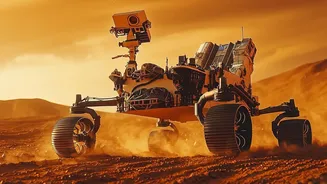
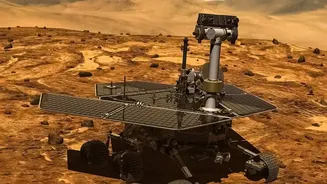
planet-encircling storms. This isn't just a visibility problem. For rovers that rely on solar panels for power, a thick coating of dust is a death sentence. By blocking sunlight, the dust starves the rover of energy, slowly draining its batteries until it can no longer function. This isn't a hypothetical threat. In 2018, a global dust storm famously ended the heroic 15-year mission of the Opportunity rover by smothering its solar arrays. More recently, NASA's InSight lander went silent in late 2022 after dust accumulation crippled its power generation. Even a thin layer can dramatically reduce power conversion, making every speck a potential danger to these multi-billion dollar assets.
A Guardian Angel in Orbit
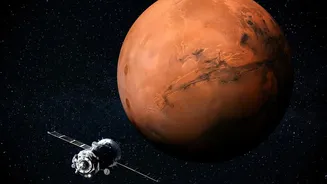
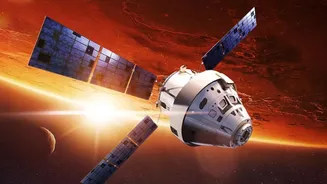
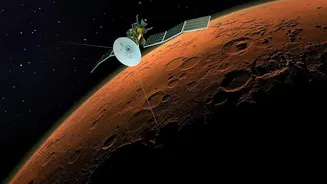
You can't send a cleaning crew to Mars, so the next best thing is to know when to brace for impact. That's where a long-serving orbital sentinel comes in: NASA's Mars Reconnaissance Orbiter (MRO). Since 2006, MRO has been circling the Red Planet, equipped with a suite of powerful instruments. Chief among them is the High Resolution Imaging Science Experiment, or HiRISE, the most powerful camera ever sent to another planet. From its vantage point hundreds of kilometers up, HiRISE can spot objects on the surface as small as a dinner table. While its stunning images of craters, canyons, and polar caps get most of the attention, HiRISE, along with the wider-angle Context Camera (CTX), plays a crucial role as a weather satellite, keeping a watchful eye on how and where dust is moving across the planet.
Learning to Read the Red Planet's Skies
Scientists are using MRO to build a comprehensive understanding of Martian dust behavior. They aren't just looking for the giant storms but also for the smaller, more frequent 'pulses' of dust activity—local and regional events that can be precursors to larger problems. By tracking these smaller storms, researchers can study how they evolve, what triggers them to grow, and why some escalate into global events while others fizzle out. Recent studies have even revealed complex interactions between different storm systems, suggesting a far more interconnected weather system than previously thought. Adding another layer of complexity, researchers have found that Martian dust storms can generate significant static electricity, creating faint electrical discharges that can alter the planet's atmospheric and surface chemistry. These observations from orbit are essential for building a complete picture of the Martian environment.
From Observation to Prediction
The ultimate goal is not just to observe Martian dust storms but to forecast them, much like we predict hurricanes on Earth. This is a monumental task. The data gathered by MRO and other missions is fed into sophisticated computer models of the Martian atmosphere. By combining real-time observations with these numerical models—a technique known as data assimilation—scientists hope to create reliable short-term weather forecasts. More recently, researchers have begun applying deep learning and AI to the problem, training models on years of dust storm data to recognize patterns and predict future activity with increasing accuracy. A reliable 12-hour forecast could give a future rover enough time to find shelter, cease non-essential operations, and tilt its solar panels to minimize dust accumulation, dramatically increasing its chances of survival.
Paving the Way for Future Explorers
This orbital surveillance is fundamentally about risk management for the future of Mars exploration. While rovers like Curiosity and Perseverance use nuclear power sources (RTGs) and are largely immune to the dust threat, solar power remains a critical, cost-effective option for many types of missions. Being able to reliably operate solar-powered rovers and landers opens up more possibilities for scientific exploration across the planet. And looking further ahead, this work is absolutely essential for the safety of human missions. Understanding and predicting Martian weather will be non-negotiable when astronauts' lives are on the line. By using our eyes in the sky to track these distant dust pulses today, we are taking the first critical steps to ensure our explorers—both robotic and human—can have a long and productive future on the Red Planet.