



More Than Just Walking with Poles
At first glance, Nordic walking looks like hiking, but its technique is fundamentally different. Originating as a summer training method for cross-country skiers, it uses specially designed poles to transform walking into a comprehensive workout. The
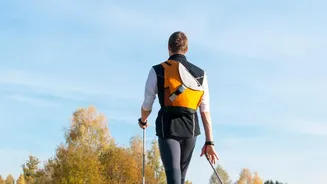
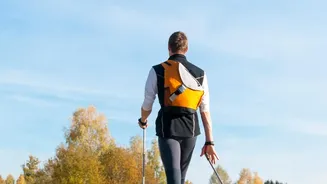
key isn't to use the poles for support, but for propulsion. As you take a step, you plant the opposite pole behind you and actively push off. This simple action engages your entire upper body, creating a coordinated movement that recruits muscles from your arms all the way down to your legs. This technique turns a lower-body-dominant activity into a fluid, total-body exercise.
An Engine for Upper-Body Strength
The magic of Nordic walking lies in how it activates the upper torso. While regular walking primarily uses about 50% of your body's muscles, adding the active push-off from the poles recruits up to 90%. This motion directly engages the major muscle groups of the upper body. Your triceps and shoulders power the push-off, your back muscles (including the lats and rhomboids) engage to control the movement, and even your chest and core fire up to maintain stability and posture. It’s the outdoor equivalent of using a cross-trainer, sculpting the arms, back, and shoulders while you walk. This increased muscle engagement is what elevates the exercise, providing a more significant workout without the high impact of running.
The Core Connection
The benefits don’t stop at the arms and shoulders. The contralateral motion of Nordic walking—swinging the right arm forward with the left leg, and vice versa—is a natural rhythm that heavily involves your core. Pushing off the poles adds a rotational force that your abdominal and oblique muscles must work to control. This constant engagement helps strengthen your midsection, leading to improved posture, balance, and stability. An upright posture is fundamental to the correct technique, with a slight forward lean from the ankles, keeping your shoulders relaxed and chest open. This focus on form not only enhances the workout but also helps release tension that often builds up in the neck and shoulders from daily activities.
The Surprising Calorie Burn
By activating so many additional muscles, Nordic walking significantly increases your energy expenditure. Studies show it can burn anywhere from 20% to over 60% more calories than regular walking at the same pace. What’s remarkable is that the perceived effort often doesn't feel much harder. Because the work is distributed across both the upper and lower body, you can achieve a higher-intensity cardiovascular workout without feeling overly strained. This makes it an incredibly efficient form of exercise, delivering more fitness benefits in the same amount of time.
From Niche Pursuit to Everyday Fitness
Once seen as an activity for older adults or recovering athletes, Nordic walking is gaining mainstream popularity across all age groups for its accessibility and effectiveness. It's low-impact, making it gentler on the knees, hips, and back than running, which is why physical therapists often recommend it. The growing movement, including in India, is supported by local clubs and certified instructors who teach the proper technique needed to reap the full benefits. Its appeal lies in its simplicity: it requires minimal gear and can be done almost anywhere, from city parks to country trails, making it a sustainable and enjoyable way to integrate a full-body workout into your daily routine.