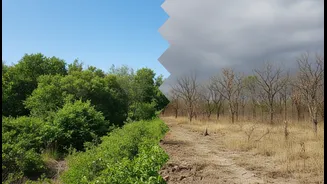








The Celebrated Greening of India
The prevailing narrative, supported by satellite imagery over the last two decades, has been one of success. India, along with China, has been a major contributor to the greening of the planet. This increase in vegetation cover has been celebrated as a significant
achievement, often linked to extensive afforestation programs, a rise in agricultural productivity, and national missions like the Green India Mission. Official reports have highlighted the expansion of forest and tree cover, which now constitutes a significant portion of the country's geographical area, as a sign of effective environmental stewardship and a step towards meeting climate goals.
A More Complicated Reality Emerges
Recent scientific studies are now rewriting this straightforward interpretation. A key finding is that while India’s overall vegetation productivity has increased and may continue to do so, this doesn't automatically translate to healthier or more resilient ecosystems. Researchers stress that a landscape can appear greener while crucial functions are weakening. This challenges the simple equation of 'more green equals more good', forcing a deeper look at the quality, not just the quantity, of India's green cover.
The CO2 vs. Water Tug-of-War
For a long time, the greening trend was partly attributed to 'CO2 fertilization'—the idea that higher carbon dioxide levels in the atmosphere help plants grow more. While this effect is real, new forecasts suggest a more powerful and limiting factor is taking over: water. Scientists now find that while CO2 and increased rainfall in some areas boost plant growth, rising temperatures and extreme weather events like droughts are suppressing it. In many parts of India, especially semi-arid regions, water availability and moisture stress are becoming the dominant forces controlling vegetation health, a factor that could stall or even reverse greening trends in the future.
Is It the Right Kind of Green?
The new research also scrutinizes the type of greening India is experiencing. Much of the increased green cover comes from intensive agriculture, not from biodiverse, natural forests. While croplands are green, they are often associated with intensive groundwater extraction, which is depleting aquifers at an alarming rate. Studies have shown that a decline in groundwater levels directly reduces the efficiency with which plants can store carbon. Furthermore, some afforestation involves monoculture plantations, which lack the biodiversity and ecological resilience of a natural forest and are more vulnerable to climate shocks like fires and pests.
The Future Isn't Green for Everyone
The forecasts are not uniform across the country. While some models project that regions like the Western Ghats and Northeast India could become stronger carbon sinks, they also warn that these same areas are threatened by rising temperatures and extreme weather. Other studies point to the vulnerability of central Indian forests and the upper Himalayas. Researchers have found that the photosynthetic efficiency of some of India’s most pristine forests has actually declined in recent decades due to moisture stress. This suggests that even as some areas become greener, India's natural carbon sinks are under a growing threat, with their ability to absorb CO2 weakening.